
Misinterpreting Reality
Vera Rubin
Roughly four decades after Fritz Zwicky's failed understanding of the nature of the missing mass, Vera Rubin wanting to forego the controversies that were prevalent in more hotly contested areas of astronomy, decided to concentrate her observational efforts on studying the outer edges of galaxies as there were not many astronomers focused on that area of investigation. Looking at the rotation curves of the outer stars in galaxies, she carefully plotted them on a graph with the expectation that the speeds at the outer edges would fall with their greater distance from the center of their respective galaxies. Remember that gravity like light follows an inverse square power law as it relates to distance. That means if you have two objects: object 1 and object 2, and object 2 is 10 times farther from the central object - say the sun - then the sun's gravitational pull on object 2 will be 100 times (the distance of 10 squared, i.e., 102) weaker than it is for object 1. Due this law she was expecting a drop of in the speed of the outer stars, because velocity is a function of the gravitational pull, in the same way that in our solar system the planets that are closest to the sun move the fastest and the ones which are least affected by it - the outer planets - move the slowest. However, this was not what she saw. In a landmark discovery, she calculated that past a certain point, the velocities of the outer stars had a flat curve, which means they had a near constant velocity with no significant drop off in their speed around the center of their respective galaxies. Again Nick puts it best:
When data doesn't match your prediction, it's time to re-evaluate things. And that's exactly what Vera Rubin did. She asked herself a question: 'what if there's more mass than we can see?' ...it was same argument tricky Zwicky made back in the 1930's, but Vera Rubin was doing it with a proper amount of evidence. Vera Rubin was doing good science. Vera Rubin discovered dark matter. This was the first time that dark matter was a legit scientific conversation." Nick Lucid
EXPLANATORY NOTE:
The above illustration is helpful in another way. The red circle outside the Earth is drawn to represent the outer stars of our galaxy that are too far away from the center to be effectively controlled by gravity alone. It was this region of galaxies that Rubin decided to make her primary focus. Expecting that they would be moving much slower than the ones inside the circle, she was surprised to see that they moved at the same rate! It was this realization, that led to the concept and later reality of "dunkle materie" - or dark matter.
You would have been wondering from the earlier illustrations depicting it, as to what the structure that lies outside the galaxy is - the one with the three undulating ribbons in green, white, and purple? That is how I represent dark matter. And from now on you will be seeing in in many different illustrations.

Vera Rubin was a prolific scientist. Throughout her career, she published papers on her latest findings and conclusions. One such paper was on the topic of galaxy distribution in the universe. Rubin was the first person to realize that galaxies were not randomly spread about, but were clustered together. This evidence showed, as we will learn later that the universe cannot be isotropic, that is, the universe cannot look the same in every direction. As we will prove later on their non random positions not only disprove a key tenet of the Big Bang theory, but their unique positions serve a pivotal role in the universe! Some quotes that we will cover later on from the Dark Energy Survey (DES) will help us to understand why!
An updated tally of the mass of the universe showed that dark matter accounted for more than 70% of the mass of the universe. A more detailed breakdown would be stars: 1.5%; planets, the rest of the material that makes up solar systems and galaxies such as planets, moons, and comets etc: 0.005% (yes that little); diffuse gas: 14.5%; and dark matter: 84%!
The War of the Worlds: Georges Lemaitre VS Fred Hoyle
The Big Bang Theory VS Steady State Cosmology
Immediately, scientists fell into two heated camps as to the possible explanation for these uneniable observations. The one camp was those who believed the hypothesis of a maverick British physicist called Fred Hoyle, who propounded the theory of a steady state universe. This was where, the was very little matter in the early universe, and as the universe grew larger and larger, more and more matter was added, hence the relationship between the volume and matter in the universe always held steady: thus the theory was named Steady State cosmology. In the other camp were those who followed the ideas of Georges Henri Joseph Edouard Lemaitre (17 July 1894 - 20 June 1966), a Catholic Priest and theoretical physicist who was also a professor of physics at teh Catholic University of Louvain, in Belgium. Lemaitre's ideas actually preceded Hubble's experimental discoveries by two years. How is that possible? Lemaitre came to his conclusions, not by experimental data, but by applying Einstein's theory of general relativity to the cosmos. The central tenet of his theory was most accurately defined in his 1927 paper entitled A Homogeneous Universe of Constant Mass and Growing Radius Accounting for the Radial Velocity of Extragalactic Nebulae. In it, he stated that the universe was expanding. Wikipedia describes what he thought to the initial state of the universe as: "a finitely sized static universe." That model was a one he borrowed from Einstein. The idea of the universe being static has held as conventional wisdom throughout history, and when Einstein heard of Lemaitre's expanding universe, he was not convinced, stating of Lemaitre's theory: "Your calculations are correct, but your physics is atrocious." In 1931, at the invitation of the British Association - a charity set up in 1831 to promote science and its development - Lemaitre put doubled down on his theory, asserting that the universe expanded from an initial point that he named the: "Primeval Atom." As his original work on the subject was only published in Belgium, and later translated by Arthur Eddington, not many people in the general public had heard of it, until at the end of 1932, it was published to a wider audience, when it appeared in the much more well known science journal Popular Science. While Einstein and others refused to believe Lemaitre's proposals for the history of the universe on the basis that they were "unjustifiable from a physical point of view"* (Wikipedia article on Georges Lemaitre), Einstein did acknowledge that he thought the theory was correct in one essential point: "Lemaître's argument that Einstein's model of a static universe could not be sustained into the infinite past."
What did that mean? That the universe being static could not explain how it originated. As we go further and further back in time there would come a point in the history of the universe when it was not static, indeed when it did not exist. As for a proper explanation as to why the universe had an observable pattern of galactic expansion, the debate raged for several decades between the two camps as to who was right: Hoyle, or Lemaitre. It is of special interest that as his Wikipedia article notes: "Lemaitre was opposed to mixing science with religion," the exact opposite of what the publication you are now reading asserts! It is interesting that the name by which Lemaitre's theory of a "primeval atom" came to be known: the big bang, was not coined by him, but by his opponent - Hoyle. As the debate raged, both sides got their chances to promote their own theory, and it was on one such occasion that Hoyle, having been invited onto a BBC radio program in 1949, dismissively referred to Lemaitre's theory as the "big bang." This state of affairs would have continued, were it not for the sensational discovery in 1965 of the Cosmic Microwave Background, seeming experimental proof that the universe did indeed start in a hot dense plasma soup, a "primeval atom" that due to the big bang expanded rapidly, until we got the universe we see today. This decisive news, was published only a year before Lemaitre's death in June of 1966. Speaking of the finality that the discovery of the Cosmic Microwave Background brought to settling the matter of which theory of the many competing theories would be adopted by science, as an explanation for the origin of the universe: Wikipedia, in an article about one such competing theory - the Milne model, proposed by Edward Arthur Milne - under the subheading "Incompatibility with Observation," describes how a theory's compatibility or incompatibility, with the Cosmic Microwave Background, spelled either its adoption or death knell within the scientific community:
Besides lacking the capability of describing matter Milne's universe is also incompatible with certain cosmological observations. In particular it makes no prediction of the cosmic microwave background radiation nor the abundance of light elements which are hallmark pieces of evidence that cosmologists agree support Big Bang cosmology over alternatives" The Milne Model | Incompatibility with Observation - Wikipedia
Thus, the prediction of and discovery of the cosmic microwave background, was regarded as an earth shattering development. It's discoverers won Noble Prizes, and the big bang theory was established as the clear victor in the war of competing theories on the origin and development of the universe. All alternatives, from the more avant-garde to serious contenders for the crown, such as Hoyle's Steady State theory were forever banished into obscurity. The Cosmic Microwave Background was a big deal. Not since Einstein predicted that the gravitational pull of massive objects - such as the sun - could bend light, had a prediction had such far reaching and definitive consequences on the direction of scientific progress; indeed on the general course of world history! From light, we turn to darkness.
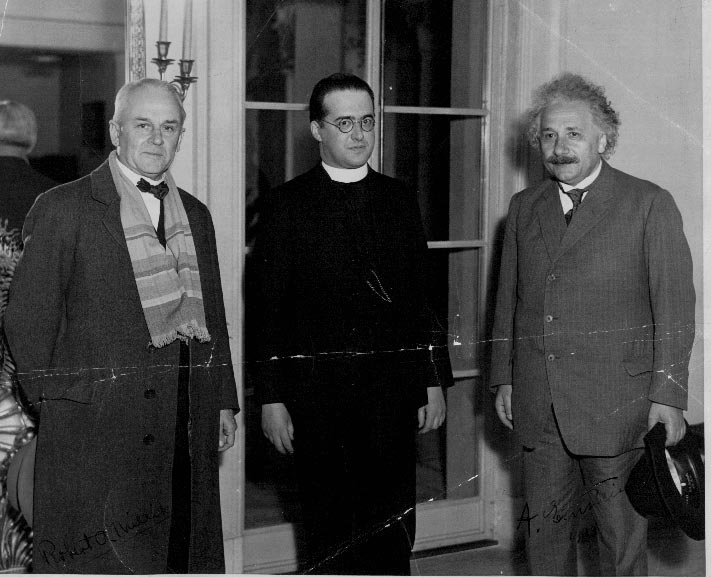
Georges Lemaitre is a most unique individual. On our journey we have come across many scientists, who profess to believe in one thing, but through their actions, prove that they actually believe in its opposite. Lemaitre, is one of those rare individuals, that while to be a devout servant of God, was actually promoting ideas, that if adopted would eradicate any claims God had to being the Creator of the universe. It was Lemaitre who proposed the Big Bang theory of the evolution of the universe. It was Lemaitre that asserted that the universe was expanding, current tense, as opposed to sticking to what the evidence showed: that the universe had expanded. We all know that as we look farther and farther into the universe, what we are seeing is a picture of its history, not its present! As all the data for the expansion of the universe, is historical, in this sense, that is, it is past tense and not what is happening today, the conclusion that the universe is now expanding, has never had any justification. This stance belied his claim of being a believer in God, who says that he has "finished creating," and is currently on his Sabbath. Put another way God says he is resting from his works, but Lemaitre, makes God out to be a liar, when he claims that the universe is still growing. It was Lemaitre who suggested the universe had a "constant mass and a growing radius," something we know is not true as per the evidence of perfect critical density throughout the universe, and at all stages of its development. It was incorrectly came to the conclusion that the universe was accelerating in its expansion, rather than realize the data suggested the exact opposite scenario, for reasons we will discuss later. In all these ways, Georges Lemaitre proved himself to be - if nothing else, certainly - an out of the box thinker, that was ready to believe all sorts of empty speculations. Anything - but the word of God!
Arno Penzias & Robert Woodrow Wilson & Robert Dicke
In 1964, two astronomers Robert Wilson (born 10 January 1936) and Arno Penzias (born 26 April 1933) had been given the responsibility to measure the brightness of the sky. To do so they were using the Bell Laboratory's Horn Recflector Antenna. This antenna receives radio waves from anywhere it is pointed at the sky. Immediately they found a very strong signal, much stronger than anything they had expected to find! Not knowing what the strong received signal was, they assumed it was an oddity with that particular region of the sky, so they pointed it at many different directions in the sky, but no matter what they did they kept recording the same sound, the same strong radio waves! Perplexed, they next tried to find any errors with their system, the horn itself or perhaps some overlooked source of noise. They tried everything to remove any and all sources of technical error including going over every inch of their equipment and cleaning it to remove any impurities including pigeon droppings. They then tried to identify any ordinary sources of error that were in the distant sky, and realized that no such sources existed. There had to be another explanation.
Stumped, the researchers tried to call around and get some input as to how to solve their dilemma from other scientists in the local community. Their first call was to a group of astronomers from Princeton University, an astrophysicist who was the Albert Einstein Professor in Science at the university named Robert Dicke (6 May 1916 - 4 March 1997) answered. Dicke was an accomplished inventor, having already developed a device called the Dicke radiometer during the second world war. It was a microwave receiver that he had used to predict that a microwave background radiation would have an upper limit of 20 degrees kelvin. Almost twenty years later Dicke was once again focused on finding the microwave background radiation and so started with the work of building an updated Dicke radiometer. It was around this time that he received the call from Arno Penzias and as the story goes, Dicke immediately knew what the source of the signal was as he had been looking for just this signal! After ending the call, Wilson describes what Dicke told his team: "Boys, we've been scooped." The developments leading up to his insight were, as told by Wilson, that Dicke had:
... Thought about a big bang source of the universe. Realized that it would be very hot and therefore full of radiation and that as the universe expanded that radiation would simply cool. And whereas, it was extremely hot to start with, by now it would simply be microwaves. Now, it is so cold, that it would just be radiowaves." Robert Wilson
With an explanation in hand that seemed to fit the facts like a glove, both research teams immediately got to work writing papers for publication on their amazing findings. They had after all just discovered the predicted afterglow of the big bang - the Cosmic Microwave Background (CMBR), and thereby confirmed the big bang theory of cosmology as empirically, factually true. Wilson and Penzias wrote about the measurement and Dicke's team at Princeton wrote about the theory behind the existence of the CMB. The most important take-away from this story is that the existence of the CMB was predicted ahead of its discovery on the strength of the Big Bang theory about the origin of the universe! What was the impact you might ask? New scientific theories usually take some time before they are adopted by the rest of the scientific community as we have already covered. But something was different with this discovery!
I think, unlike many changes that occur in science, there really was a paradigm shift, with very little push-back.Robert Wilson
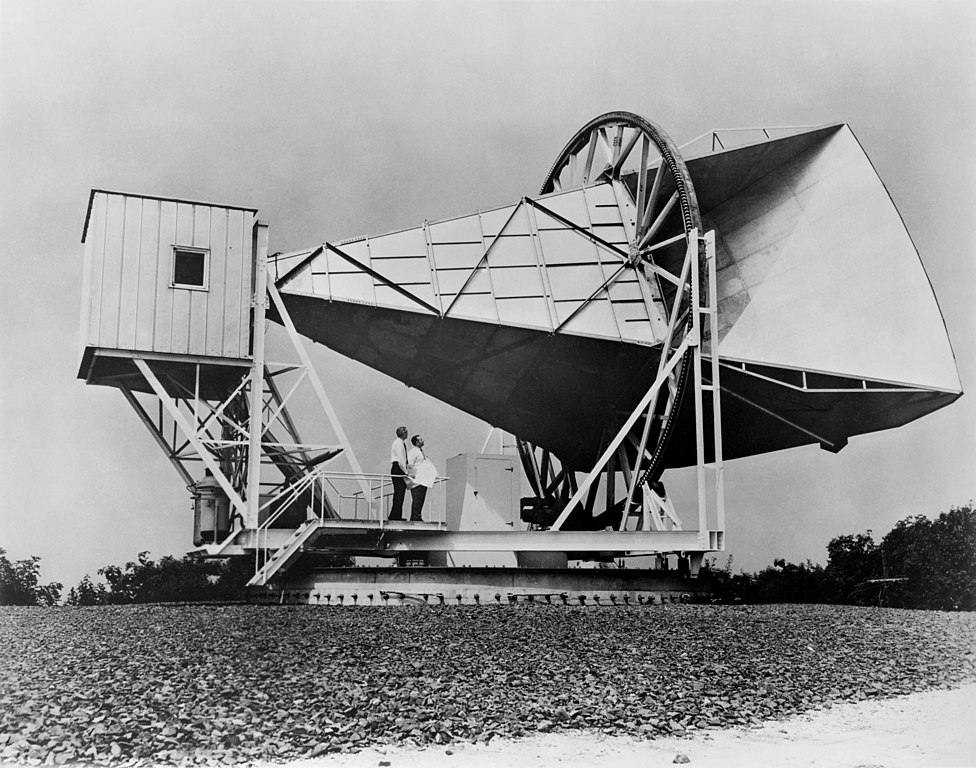
In 1978, almost a decade and a half later, Wilson and Penzias were awarded with the Nobel Prize in Physics. What a triumph of scientific research, deduction and reasoning they and Dicke's efforts in collaboration with his Princeton team had proved to be. Or was it?
Saul Perlmutter and Adam Riess
Saul Perlmutter (22 September, 1959 - ) and Adam Riess (16 December 1969 - ), will forever be tied at the hip - scientifically. That's because they were each heading rival teams of scientists vying for the discovery that would pin down the veracity of science's most important theory, the Cold Dark Matter . These two luminaries in cosmology, represent a dramatic turn in our narrative of the history of science. For the first time we are speaking of people who are still alive and active in their fields! Our journey of exploration has taken us from Plato to Copernicus, from Galileo Galilei to Sir Isaac Newton. From Faraday to Clausius, to Henrietta Swan Leavitt, to Vera Rubin and Penzias and Wilson and finally, right down to our time. The hard work is done. Now, we put it all together to reveal the long held secrets behind the origin and development of the universe. We have gathered all the tools we will need in our treasure hunt, the only task now is to employ rigorous logic to reach the inevitable conclusions that the scientific method always produces!
Our last two scientists achieved acclaim, including being jointly awarded the 2006 Shaw Prize in Astronomy and the 2011 Nobel Prize in Physics! Their great achievement was the nearly simultaneous, though independent empirical establishing, through experimental proof, that the expansion of the universe is expanding! Perlmutter, led a team called the Supernova Cosmology Project, at the Lawrence Berkeley National Laboratory, while Riess jointly led the High-z Supernova Search Team, along with Brian Schmidt. It was Reiss' team that was first to publish evidence that the universe's expansion rate was accelerating. They studied the colour shifts of the light emitted by Type 1a supernovae, and used their calculations to show that these stars were still accelerating away from the earth.
Critical Mass is a book published by science writer Phillip Ball in 2004. Its byline was: "How one thing leads to another." I use title Uncritical Mass somewhat cryptically, to communicate that the great discovery that won the 2011 Nobel Prize for Physics was not an instance of critical mass, of one thing leading to another, but in short order will be discovered to be one of the biggest blunders in Science history! The joint winner of that Nobel Prize, Saul Perlmutter was the head of one of two teams who displayed a shocking lack of critical thinking in 1998, when they announced to the world that the universe was accelerating in its expansion. This error was a continuation of an ill conceived notion first proposed by Georges Lemaitre in 1931 - 67 years earlier! The inconsistency in the logic of this assumption are two-fold: first interpreting what happened historically, for evidence of present day dynamics, that is confusing history with the present day. The deeper we look into space, the farther back in time we seeing. Everyone knows that much. Hence, any events that we are currently "seeing" in deep space are historical events, and not current ones! Thus we can never project historical data onto present-day-dynamics, by saying data from deep space shows x and y, thus the universe is doing such and such. We can only say data from the past tells us that in the past the universe did such and such. The second oversight is even more fundamental and glaring: as Hubble observed galaxies in deep space exhibit redshift, which is interpreted as a recessional velocity, which means they are moving away from us at a certain speed. But there is a second variable that goes with the redshift data, the farther away the galaxies are, the more they are red-shifted. This means increasing distance results in higher historical velocities away from the earth. Since the deeper back we look, represents the farther back in time we are seeing, this data means historically, the further back in time we go the faster the galaxies in the universe were moving away from the earth. And the closer we come to the present day in analyzing the data, the slower the galaxies are moving away from us. Of course, today the nearby galaxies such as Andromeda, don't show any red-shifted acceleration, away from the earth. Which means the universe is no longer expanding! Putting this all together leads to the conclusion that in the past: the universe underwent expansion, initially at a fast pace, then the expansion decelerated with time. All this is in the past tense. It is referencing historical events. Hence, all we can actually say, from the evidence is that the universe expanded in the past, first quickly and then at a slower pace, and currently all evidence suggests there is no expansion, just evidence of the galaxies going through their normal local cosmic dynamics - such as angular momentum etc. Lemaitre, and Perlmutter and Riess after came to the opposite conclusion, from the same data, we have just analysed! They concluded that not was the historical data to be applied in the present, but they swapped timelines by interpreting the chronology of events in reverse: hence, they concluded that the universe was currently accelerating its expansion. 0 for 2. Wrong on both accounts. If a Nobel Prize is recalled, does the recipient have to return the prize money - with interest?
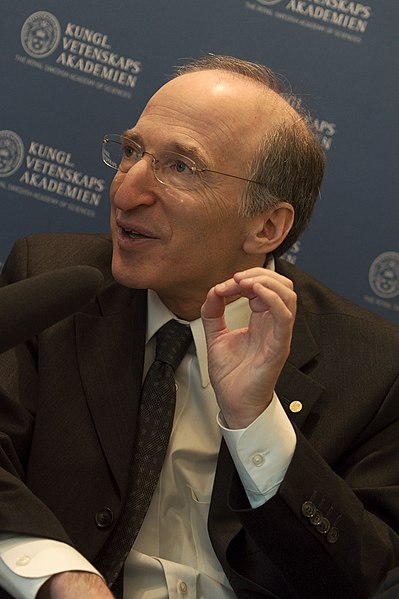
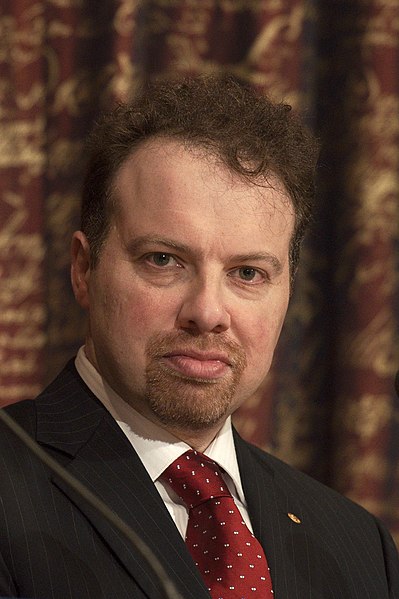
Adam Riess is a staunch defender of the work he and his team did in co-discovering the expansion of the universe - and subsequently the force that was supposed to be responsible for driving this expansion, dark energy. A metaphysical speculation which is thoroughly debunked elsewhere in this volume. This co-recipient of the 2011 Nobel Prize in Physics' defense of his theory extends to entering into vigorous debates with anyone that contests his findings, as he done with Subir Sarkar, whom we also cover in detail in this blog. He claims Sarkar is not interpreting the data correctly, and that there is a mountain of evidence that support his claims. But, as seen from the above comments on the profile of one of his co-winners, Saul Perlmutter, his discovery is dead on arrival, just based on critical thinking and sound reason. This is before anyone even takes a detailed look at the data. Their assumptions and model are wrong, hence all that follows is wrong - even if the data was correct, which it is not! As Giordano Bruno once noted: "If the first button of one's coat is wrongly buttoned, all the rest will be crooked.." A much constructive use of Riess' time, and indeed all cosmologists/astrophysicists would be to determine what we will call the: present day horizon. In other words, we all know that the farther we look back into space the further back into history we are peering: but where in space does that history start? Put another way: When we look at a far away galaxy, we are looking into history, since the light took many years to get to us, we are seeing that star as it was in the past; not as it appears today! However, that is not true when we look at the moon! When we look at the moon, we are seeing it as it is today. The same goes for the Sun, since we know that it takes light just over 8 minutes to reach us from the Sun. The same is true for all the planets and celestial objects within our solar system. Where is the one day mark? That is, what is the radius at which, when we look at objects at that distance, we are seeing them as they were yesterday? We can similarly find such radii or horizons for one week, one month and so on. In fact we know them. So why have scientists not worked out the horizon for when we can consider events to be taking place contemporaneously with us? Such a horizon would make the points I have elaborated on in Perlmutters blurb obvious. We would know point blank, that if we are discussing/analyzing events past the present day horizon, we are speaking of historical events, and wouldn't make the foolish mistake of conflating historical data with present day dynamics. Can you guess why scientists have not defined such a horizon? Only in its absence, can they bamboozle a gullible public into believing their metaphysical speculations uncritically. No one today can claim that the war in Ukraine is the second world war, because that war started and ended, the war in Ukraine is currently under way. The distinction is clear, and there is no need for explanation. Similarly no one would conflate historical cosmic events with current cosmic events if the present day horizon, were clearly defined. It hasn't been defined because not having one, allows cosmologists to create time-traveling back to the future, science fiction models of the history of the universe.
To refresh our memories, Type 1a supernovae (type of explosion) are all believed to occur in the same way, hence their use in astronomy, as standard candles. Whenever, such explosions occur, their intense luminosity is measured against the known luminosity of such explosions, and scientists can then determine their distance from the earth by comparing the two figures. Furthermore, by comparing the calculated distance agains their redshift, both their distance and velocity can be known. Having conducted such tests and calculations, both teams independently concluded that the supernovae were receding from the earth faster than the Hubble allowed for. What could that mean? Their conclusion: the expansion of the universe was increasing in speed. So, to be clear, the foundational pieces of evidence behind these findings, were the 1) the Hubble constant and 2) the fact that the observed velocity of the distant supernovae exceeded the Hubble constant - pointing to an accelarated rate of expansion. Just like with the discovery of the cosmic microwave background, both teams involved published their findings almost simultaneously. I'll let Wikipedia summarize what came next,
The two teams' reports were published within weeks of each other, and their conclusions were readily accepted by the scientific community due to corroborating theories. This conclusion has subsequently been supported by other lines of evidence. These findings reinvigorated research into the nature of the universe, and especially into the role of dark energy. For this work Perlmutter was awarded the 2011 Nobel Prize in Physics, shared jointly with Riess and Schmidt" Saul Perlmutter - Wikipedia