
A Look into the Constitution & Dynamics of Dark Matter
Cold Dark Matter
In trying to understand dark matter, we will be reviewing all of its confirmed features and properties. And in doing so, we must make one thing clear, we will be like people who come in after a war and try and clear the land of deadly minefields. The reason is that scientists have no idea, what dark matter could be. And never being satisfied, with just acknowledging what the data says, that is, in practicing "hypotheses non fingo," hence they are always muddying the evidence with their own unfounded, biased theories. Even in the darkness, of knowing so little about its nature, they are nonetheless, always going beyond the empirical evidence on the subject, and thus not practicing the scientific method. Hence, in reviewing different statements about the evidence, obtained from the quotes of various scientists and publications, we will always find ourselves having to separate the wheat from the chaff. All we need, in order to do so is humble restraint as our guide, and the solid foundation of reason and logic. In this exercise of removing opinion from fact, it might appear that I am cherry picking what statements I highlight to be true, but nothing could be further from the truth. The truth would be, only the statements that are backed up by empirical evidence and observable facts will survive the filter of approval. And this you can all check for yourselves, for the little that is known about dark matter is universally acknowledged. The problem is, most scientists then add their own personal unfounded opinions to the data, in an effort to create a full a picture as possible, as to what dark matter could actually be. A central part of trying to comprehend the true nature of dark matter, is understanding why it's called dark matter, and why that name is inappropriate. All scientists, agree that the name Dark Matter, is inappropriate for the substance they are trying to describe with that label. When Fritz Zwicky initially popularized the term "dunkle materie," many accepted it, perhaps feeling that since the name represented some non-luminescent substance - it was fitting. Hossenfelder, says the better term to use is transparent, but that too is not sufficient - for reasons that will become immediately apparent, once we read a description of its properties below:
Dark matter is called 'dark' because it does not appear to interact with the electromagnetic field, which means it does not absorb, reflect, or emit electromagnetic radiation ... and is, therefore, difficult to detect" Dark Matter Article - Wikipedia
We are all familiar with transparent objects, like windows and glasses and the screens on our computing devices, be they tablet; smartphone; desktop or laptop. The $5 000 Apple Pro Display DXR came with a $1 000 option, for a nano-textured glass. Why such an expensive option? It reduced glare from the highly reflective transparent surface of the screen. Thus, it is obvious that Hossenfelder's suggestion to rename dark matter, "transparent matter," is completely unsatisfactory. As quoted above dark matter, "... does not absorb, reflect, or emit electromagnetic radiation," Since transparent materials do reflect light, it is not a suitable name for what we are trying to describe. But a rose, by any other name would still smell as sweet. What is of far more pressing importance for us, is to come to understand thoroughly, the features and properties of dark matter, so as to get a firm mental grasp of its utility, and important significance, for:
Names and attributes must be accommodated to the essence of things, and not the essence to the names, since things come first and names afterwards" Galileo Galilei
Once, we have come to appreciate its 'essence,' we will be able, to easily give it, a proper and fitting name. As scientists, openly declare that they know very little about dark matter, our efforts to appreciate dark matter's properties, will be centered around using what evidence has been at hand, to correct misconceptions and unjustified assumptions about its nature. The error, that most make is to overreach and form theoretical models that go beyond what the evidence itself confirms to be true. As Newton declared, "Hypotheses non fingo." I frame no hypothesis. We will start our efforts with familiarizing ourselves with: 1) the scale of dark matter in the universe; 2) its structure: in other words, where it can be found and more importantly, where it cannot be found; 3) its functionality; 4) its utility in the universe, as established by its observed effects on its visible, baryonic contents; and 5) the two independent lines of evidence for its existence. And as we do, we will keep updating our evidence-based model of the universe, so that knowledge equals experiment, for as Feynman put it, "The test of all knowledge, is experiment." We always want to ensure that those two factors, are in sync! And then never go beyond what is experimentally proven when making claims. To that end, let's revisit both independent lines of empirical evidence for the existence of dark matter.
Two Lines of Evidence for the Existence of Dark Matter
Gravitational Lensing?
Blurry vision and poor eyesight happen when the eye cannot focus the light rays at the right point, for our optic nerves to turn the signal into a crisp clear image. To correct this, people with poor eyesight get corrective lenses, that focus the incoming rays at the right spot. Something similar happens with gravitational lensing. Some explanations of gravitational lensing show two parallel rays going towards the center of a galaxy. Then due to the mass of the galaxy in question, the rays are diverted around the galaxy and converge again on the other side, to once again resume their parallel journey through the universe. This is a wholesale misunderstanding of the dynamics of gravitational lensing, that is based on geodesics and the non-existent spacetime. In reality, what happens is that, the rays that are traveling in a divergent - not parallel - fashion to each other hit the edges of a galaxy and are curved around the galaxy and bent back inward as they continue their journey. Since, they are now, no longer divergent but convergent, they will meat at a certain point in the course of their journey. If that focal point is exactly where the earth or our telescopes are then we see an image produced by a gravitational lense. If it is in front of the earth and our equipment, we see nothing. The same is true, if they converge behind the earth. As for parallel lines emerging from a background galaxy, and traveling towards the center of an intermediate galaxy, that is acting as a gravitational lens, they do not get bent. If they are obstructed on their journey, by some object within the intermediate galaxy, we will never see them - because light doesn't travel through opaque objects. As we have already learnt. If they manage to pass through unimpeded, and we are in their line of sight, we don't see gravitational lensing, we just see starlight! It is important to take the time to appreciate the nuances of these different situations. Below, there is an illustration of gravitational lensing. Below that, I have also included another illustration based on geodesics. Comparing the differences between the two, will go a long way to clarifying what gravitational lensing is and is not, for you. Gravitational lensing, once you have taken the time to understand it, is - you will quickly realize - a watertight proof for the existence of dark matter! If you understand the difference properly, you will also have an Evidence Profile for why geodesics can never produce gravitationally lensed images.
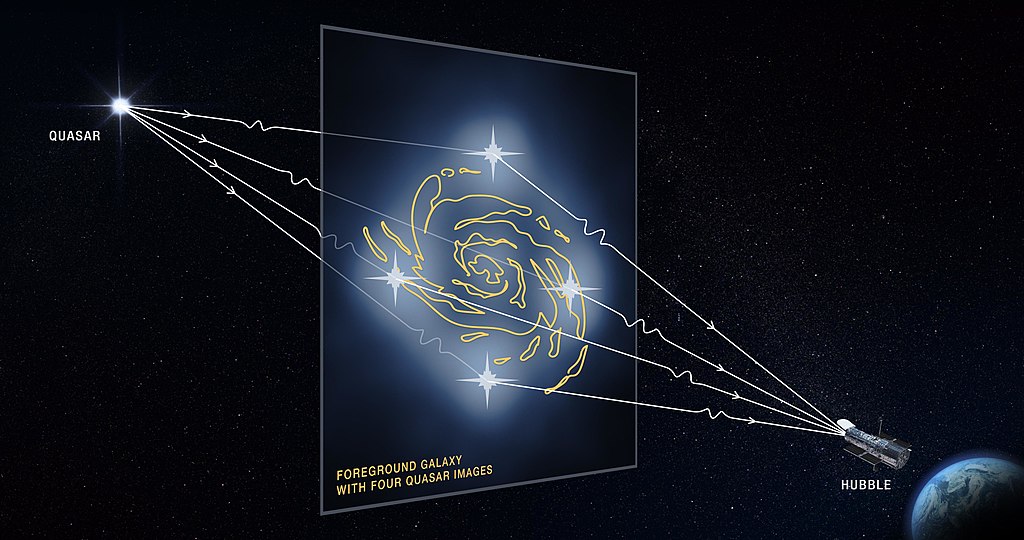
EXPLANATORY NOTE
It's quite simple. Seeing is caused when different rays of light CONVERGE on a focal point to cause an image. You can immediately see the internal contradiction between the explanations for gravitational lensing - if it is supposed to be created by spacetime, and its geodesics! The geodesics are only bent in the immediate neighbourhood of the large gravitational object, be that a supposed blackhole (as in the illustration below), or a galaxy. Thereafter, the geodesics again become parallel - meaning they will never produce an image. That is why, above, they show multiple lines of sight (incoming rays), but below they only show one!. An image is not a point light. It requires multiple incoming rays to create it. The problem is above the rays all converge on a
focal point - the Hubble telescope. But according to the spacetime model of the universe, geodesics run parallel to each other at the very same point (in the illustration below)!
These explanations are not compatible. Only one can be true. Since we do see gravitationally lensed images, it means the illustration above is the one that agrees with observational evidence - and the geodesics of spacetime have been proven to not be the source of gravitational lensing. It is thus, not the mass of the galaxy, bending spacetime that causes gravitational lensing, but something else! What, then, is gravitational lensing - a function of?
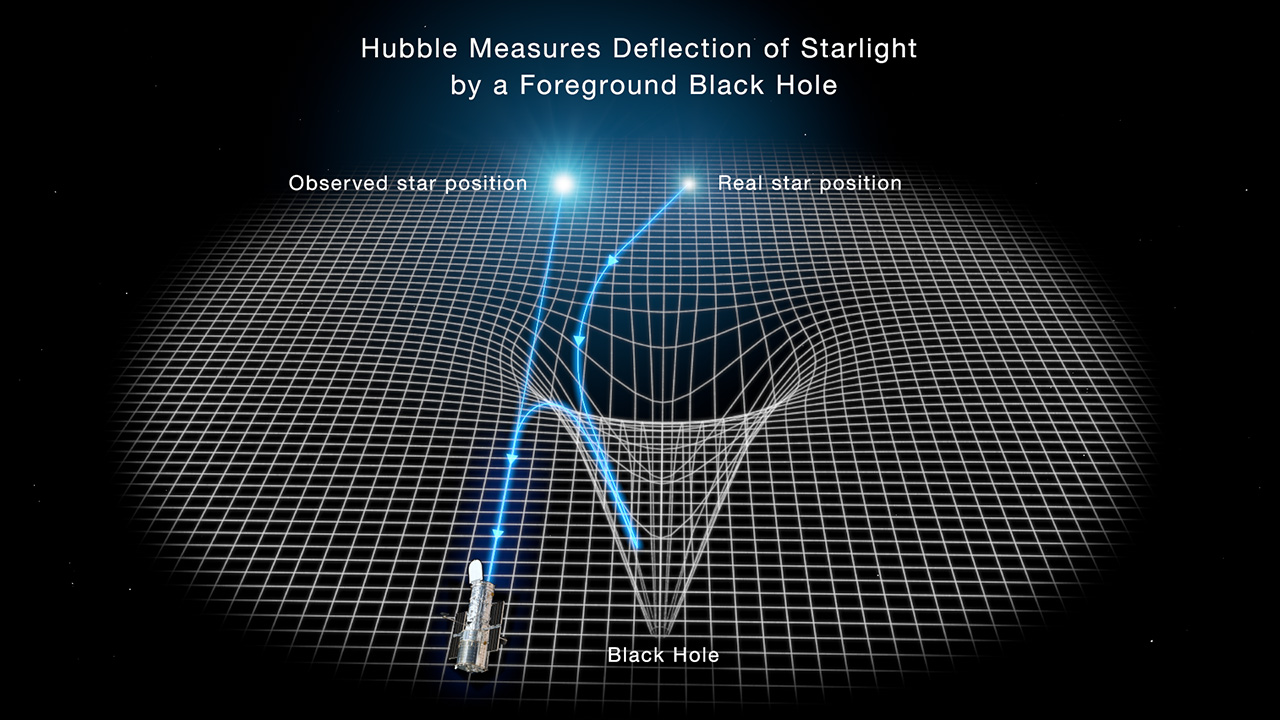
Having come to understand that the theoretical entity called, spacetime, and its geodesics, cannot be the source of gravitational lensing, we realize that another structure must be responsible for this function - for it is not magic! The graphic below helps us to identify the responsible entity! Remember, that there are huge distances between us and the galaxy that is acting as a lense, between us and the even farther away, galaxy that is being gravitationally lensed! So, as depicted above, by the time the light rays reach Earth they are no longer within a strong gravitational field (according to the theory of spacetime), and thus, the geodesics along which they are traveling have long since straightened out - and have been parallel, for many, many lightyears. In that case: how do they form an image when they reach our telescopes? They cannot! This is how we know it is another element in the universe that is responsible for the producing the function of gravitationally lensed images, for it cannot be spacetime, and its geodesics - by definition of the creators of the model. Above, the illustration only shows one light ray, which is not enough to create an image. A second light ray from the original star, that traveled along a geodesic on the other side of the black hole would be 11 or 12 geodesics away from the exit line on the left upon exiting the strong gravitational field. In that case, how would the two light rays, converge to create an image? I trust the matter is clear. Although, we will discuss it later, in more detail.
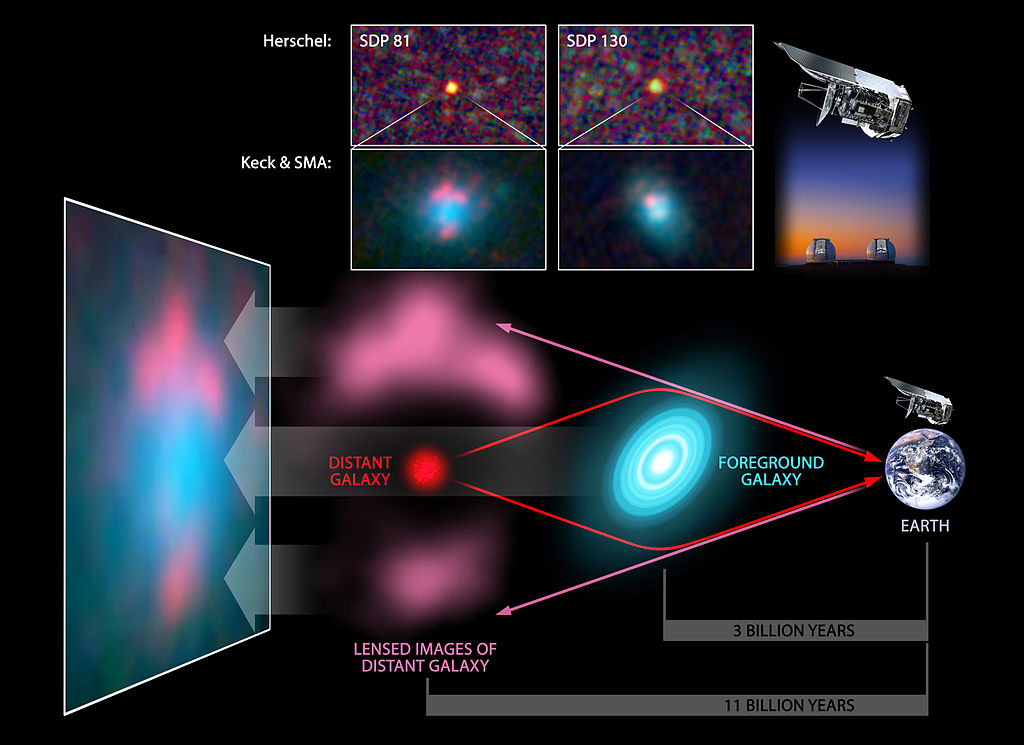
It should be obvious to you that this depiction is the Evidence Profile that agrees with all the empirical evidence, including all observational data. For one: the focal point is accurately depicted. In this image we identify that it is the galactic halo - not the galaxy itself, that is bending the light rays! For reasons already stated above, we know it cannot be due to geodesics, because, after they leave the local area of the galaxy in question, they again diverge, and thereafter travel in parallel lines! That means they will never create a focal point - and a resultant image!
Rotation Curves of Outer Galactic Stars
We remember the great work Vera Rubin did regarding the rotation curves of galaxies. Gravity falls off in a predictable way, through the mathematically precise inverse square law. Essentially: the strength of the gravitational force is the inverse - meaning 1 over the relevant number - of the square of the distance between two objects. If the moon were to be move to twice the distance it is from earth currently, the gravitational pull would decrease by the square root of two i.e., the gravitational force would be 1/4 of what it used to be. If the distance moved was 5 times, its current distance, the resulting gravitational pull would be 1/25 times weaker, etc. With the vast distances that are involved on the galactic scales, you can imagine how much weaker the gravitational pull a galaxies inner matter has on the outer matter - the outer stars. Yet, as we know when Vera Rubin measured these rotational rates for the outer stars, she found to her great surprise, that they were moving as if there was much more matter than was visible to the eyes. Hence, the mysterious hidden matter, responsible for keeping these outer stars from slowing down and flying off, was dubbed dark matter. Rotations curves are a second, independent confirmation of the existence of dark matter.
I leave out a third independent line of evidence. Scientists assert that the CMB gives proof of the existence of dark matter. However, their analysis is wrong. So, although, they are right about the CMB proving the existence of dark matter, it is not, for the reasons they espouse. For that reason we will leave them out. As we proceed with our exposition, I will show conclusively, the real reason the CMB proves the existence of dark matter. For now, let us move on to what the evidence tells us about the scale of dark matter in the universe.
The Scale of Dark Matter in the Universe
Universe-Wide
Dark matter as we know, is the scaffolding of the universe. Wherever, galaxies and visible matter, has been found in the universe, dark matter surrounds it. The universe is defined as everything that exists, hence since all the baryonic matter that exists is found within dark matter, we can confirm that its label as the scaffolding of the universe, is accurate. How do we know that everywhere visible matter is found, dark matter surrounds it? In addition from the proof of gravitational lensing, the map compiled by the Dark Energy Survey - using the technique of gravitational lensing - confirms it:
the galaxies serve to illuminate the dark matter scaffoldingAlexandra Amon
And again ...
Galaxy clustering, it's sort of just a name for the fact that, galaxies, they aren't distributed sort of uniformly, randomly in space, they exist in a web. And that's what we observe. We observe this web" Justin Myles
Both of the above quoted scientists, work at the Dark Energy Survey. Their comments bring clarity to our discussion, first Amon: due to gravitational lensing, the light of the galaxies "serves to illuminate the dark matter scaffolding." Her colleague, Justin Myles brings the point home, "... galaxies ... exist in a web. And that's what we observe. We observe this web." How? Because, it is illuminated by the light of the galaxies that sit inside it. The lights in a home are left on. How do we know there is a house there? Because the lights shining through the windows, show us that there is a house. Though, more involved, the situation with galaxies and their dark matter scaffolding is exactly analogous to our lights and home example.
For reasons we will only discuss later: we can confidently state that the CMB is also, ensconced within the dark matter scaffolding - and we know there is nothing outside the CMB, for it is the Celestial Sphere! We need a little more exposition, before we can explain why, but keep the thought at the back of your mind. For now, we will only conclude this section, by restating this empirical truth established by observational data - the dark matter Cosmic Web's dimensions reach across the entire universe.
The Structural Framework of Dark Matter
Why is it Called the "COSMIC Web?"
The first thing to realize about dark matter is that it is spread out throughout the universe, hence the term "Cosmic," in its title. Everywhere there are galaxies throughout the universe, you will find dark matter: for throughout the universe, galaxies are only found inside dark matter. For this reason dark matter, or the cosmic web forms the large scale structure of the universe. Anyone who is acquainted with astronomy, astrophysics or cosmology has heard this term before: the "large scale structure of the universe," but what does it really mean? Earlier we spoke about how the distance separating the Milky Way galaxy from our nearest neighbour - Andromeda - is about a 1 Megaparsec. To be more precise, it is about 0.8 Megaparsec, or 2.6 million light years. In other words, it would take us 2.6 million years, traveling at the speed of light to go from one galaxy to the next - it's quite a distance. In comparison, the Milky Way is only 105 700 light years across - almost 25 times smaller, with Andromeda being more than twice the size of the Milky Way, at 220 000 light years in diameter. Andromeda, is the largest member of the local group of galaxies, that includes, our own Milky Way. That makes, the distance between these two galaxies almost 8 times their combined diameters! 2,600,000 light years, versus 325,700 light years. That is what the universe looks like at galactic levels. Things looks separated and unconnected! This appearance doesn't change much at the galaxy cluster level. Galaxy clusters, are groups of local galaxies clustered into a local neighbourhood - and of course, such clusters have much larger distances separating them from one another. And the story continues in exactly the same manner, as you move up in scale and find galaxy super-clusters, which we will just call super-clusters, since we know that we are talking about galaxies. The point, then, is there are huge distances that separate celestial objects in the universe. And if we didn't know anything about dark matter, that's were our understanding would stop. We would think celestial objects exist as solitary islands with vast empty spaces between them. And, there would be no rhyme or reason for why, the celestial objects in the cosmos are positioned as they are. However, dark matter has revealed another, deeper layer to the relationships between the entities that make up the Cosmos, and an underlying invisible structural component of the universe: the galaxies are ALL connected to each other through criss-crossing invisible ribbons of dark matter, called filaments! Since, dark matter is not visible, what looks like disconnected islands to our eyes, is actually revealed to be interconnected when viewed through the dark matter network that reaches into every corner of the universe! It is this invisible universe-wide structure that is known as the Cosmic Web!
It is this realization: that only by viewing the universe through the filter of dark matter, can we come to appreciate and comprehend, the interconnected nature of the whole universe, that gives rise to the phrase - the large scale structure of the universe. But how is dark matter, itself constructed? Is dark matter an all pervading Ether? Is it something that exists at all places, throughout the universe at the same time? Not at all. Which leads us to our next subheading ....
Why is it Called the "Cosmic WEB?"
It is critical that, as we add to our knowledge of dark matter, we keep reviewing what we know about the 'physical' structure of dark matter. We use that word cautiously, for physical relates to baryonic matter, but we just mean: though dark matter is not physical in the baryonic, atomic sense, it does have structure - it is something! Currently, we know the extent of that structure: it is universe-wide. Meaning, anywhere where there is matter in the universe, such matter is found inside dark matter filaments. Now, we want to know what is the shape, of that universe-wide cosmological structure? The name, is of course, self-explanatory in that regard: dark matter "manifests" itself, in the shape of a web - a cosmic web.
All webs, are like mathematical networks, in that they have three distinctive features. For networks, those features are: edges and nodes; for webs: they are strands, and the points where the strands connect. The nodes are the points where, two or more lines meet, and the edges are the name of the lines, that connect nodes. Since, physical webs, like spiders webs also have these features, we will similarly, call the point where two or more strands intersect - nodes. Of course, we mentioned three features, but only listed two. That is because the third, the spaces between the nodes and edges in networks; or nodes and strands, in the case of real life webs, is taken as a given. It does not have to be formally articulated, because, as soon as you stipulate where the nodes and edges go, the empty spaces in between come into existence as a natural consequence. However, such empty spaces are vital to the function of the web, as a whole, as they have a function that is complimentary to the strands, and nodes. For instance, think of a spider's web. The reason spiders can catch prey on it, is that the web's strands are so thin, that the prey sees empty space until it is too late. By the time the prey sees the strands, it is caught in the web. So there is a complementary relationship between the strands and nodes, and the empty spaces that separate them. We will call such empty spaces, Voids. We define these 'voids' to have complimentary functions to the physical parts of the web - the strands and nodes - because they show, what not being part of the node or strand looks like! This idea, might seem a little abstract initially, but you will see its practical applications later, as we consider more examples of its usefulness. For now, we merely acknowledge that the shape of the cosmic structure that forms the scaffolding of the universe, is a web! That is, it is a structure that has: 1) nodes; 2) interconnecting strands, and; 3) vast empty spaces between all the nodes and the interconnecting strands, that connect them! Lastly, we acknowledge that the nodes and strands, have a different functionality from the voids, and that studying this difference, serves to clarify and highlight the utility of the functions of the nodes and their interconnecting strands. As our interest in reviewing this information, is not to understand webs in general, but to understand the Cosmic Web, in particular, it is fitting that from now on we refer to the nodes, their interconnecting strands, and the vast empty spaces between them, by the terms more naturally associated with cosmology and the cosmic web: Halos, Filaments and Voids!
Where Dark Matter Can, & Cannot Be Found!
In this section, we will come across scientists making many claims, many of which contradict each other, some in subtle ways, others much more glaringly so. This happens because they are mixing the evidence with theory, and have not given enough thought to the logical consequences of their assumptions. For this reason, we will only pick out what harmonizes with verified empirical proof. It will not be a case of me cherry-picking their statements and highlighting only what agrees with my thesis. Not at all. All their statements, will be tested against known observational data. This will allow the evidence to determine what aspects of these scientists assertions is valid - and what part is unfounded speculation. Thus we will be able to separate the wheat from the chaff. By being disciplined enough to always let the evidence, be our guide, we will avoid falling into a similar trap, as our ever-speculative scientists. Scientists at Japan's National Astronomical Observatory who study the night skies to find dark matter and catalogue the distribution of dark matter say,
Initial results from observations covering an area of 2.3 square degrees on the sky revealed nine large concentrations of dark matter, each the mass of a galaxy cluster" Japan's National Astronomical Observatory
However that assessment is not very helpful, as it only does tells us that dark matter is found in masses approximating galaxy clusters. It tells us nothing about how much dark matter is found in such clusters, where it is and is that the smallest scale that dark matter appears on? Neil DeGrasse Tyson, in a video where he discusses the properties of dark matter, gives us more information through the following statement:
Now, 'dark matter' is not even what we should be calling it, because that implies that it's matter; it implies we know something about it that we actually don't ... A galaxy ... is the smallest aggregation of matter where dark matter manifests" Niel DeGrasse Tyson
Clear and precise. What does it mean? The quote's meaning becomes clearer, when we phrase it, in its negative form: dark matter does not manifest on scales smaller than galaxies. So, far we know dark matter shows up at the scale of galaxy clusters, and on the scale of galaxies. Scale-wise, galaxies are smaller than galaxy clusters, in the same way a grape is smaller than a cluster of grapes. So the last quote gives us a clearer picture, but let's test our understanding of the minimum scale, at which dark matter is found, by asking: is there any dark matter in our solar system? The clear and immediate answer, to all of us should be "no," since solar systems are smaller than galaxies: and "A galaxy ... is he smallest aggregation of matter where dark matter manifests." For proof we will look to a video by Nick Lucid of YouTube's, The Science Asylum channel,* and parse out his reasoning. The discussion takes place in the form of a Q&A session between him and his wife - who apparently goes by the name Awkward M ... the transcript follows:
Nick Lucid: The [dark matter] halo, is a region of the galaxy outside of the disk.
Awkward M: Outside of the disk?
NL: The galaxy is spun into a disc, a spiral disc, which is where most of the luminous matter is. And then, the halo is everything outside of that ...
So far, so good. From all of the above, we have now established two things: 1) the smallest scale at which dark matter is manifested is on a galactic scale, and: 2) on such galactic scale, dark matter manifests as an all enveloping halo, that is outside of the disc of the galaxy. We continue ...
NL: Based on our evidence of dark matter, it has a few properties that we can say conclusively about it. Now we call it dark matter, but it should really be called Invisible Matter. It's actually legit, invisible. It doesn't interact with light, at all! ... And if it doesn't interact with light, it's not electromagnetic - at all! That means we can't put it in a container either.
AM: Why?
NL: Because the reason that your hand doesn't go through things, is because of electric repulsion, right.
AM: Oh.
NL: The electrons in your hand ...
AM: From the subatomic particles.
NL: Exactly
AM: Okay.
NL: We know that if it doesn't interact electromagnetically, then it doesn't do that. And so, you couldn't put it in a container. It'll just pass right through the walls of your container. Not only can it not be seen, it also can't be held.
AM: Do we have dark matter in our galaxy?
NL: Absolutely. We have dark matter in our solar system.... Now there isn't much of it. We know what density, we should expect it to have. And that density is extremely small! We're talking like if you took all the dark matter in our entire solar system, out to Neptune's orbit, and you collapsed it into an object. it would have the mass of a medium sized asteroid.... But, if it doesn't interact electromagnetically, then it wouldn't ever form an asteroid.
AM: Right. Why would[n't] it?
NL: That electromagnetism, is what slows things down and generates heat, and - like - saps energy away. And so, if it doesn't interact electromagnetically, then it doesn't slow down, which means it can't clump. The best we can do [in terms of modeling how it looks] is just a diffuse cloud of it. A cloud of stuff that can't be seen and doesn't interact with anything - except gravity.
AM: Invisible?
NL: Hence, invisible! So we can only see it based on its gravitational effects.
AM: I mean, but, have we actually found its gravitational effects in the solar system?
NL: No.
AM: No?
NL: Because, there's not enough of it. An asteroid mass isn't going to do much to our solar system. Which, is why we don't see it here. And, we don't see it on a, you know, stellar scale either. It has to be an interstellar galactic scale before we start to see its effects.
AM: Okay
NL:* (-6:36) Before the scale is large enough that there's enough mass, to actually do something. While, technically, the dark matter is here, and it is gravitationally affecting things, it's not really that much. There's much, much bigger influences. But, the point is, that the overwhelming majority of this effect must be matter! We know that it's matter!
Let us unpack Lucid's thinking. You can tell that he feels quite strongly that dark matter is matter, in contrast to Degrasse Tyson, who took the approach that we shouldn't even be calling it matter, since we don't know what it is! Although Lucid, correctly follows the evidence in understanding that dark matter does not interact electromagnetically at all, hence it "is legit invisible," he fails to divorce his expectations from the properties of baryonic matter. Gravity increases with the amount of baryonic matter present. That is not an assumption, you can carry over to dark matter. In contrast, when it comes to dark matter's electromagnetic properties, he correctly shows why dark matter cannot be contained, or held; since, unlike our hands, it doesn't experience "electric repulsion," because it doesn't have electrons, or other subatomic particles. It is not baryonic. Recall, that baryons, as in baryonic matter (physical matter) are defined as "any of a group of subatomic particles...."*(MW)
A second problem with Lucid's analysis, is that he imagines dark matter to be a "diffuse cloud." It is NOT. The cosmic dark matter web is made of filaments of dark matter, as is universally recognized. Any Google search will bear that out. Filaments are like strands of a rope. They are alternately called tendrils, though that is a less popular term for them. Dark matter halos, are nothing more than where the filaments intersect. Filaments, do not suddenly change to being diffuse clouds, when they intersected with other filaments? No, instead, the cosmic web has a filamental structure throughout, even where the filaments intersect, only then, they form a node! These nodes are just an accumulation of intersecting filaments. The reason baryonic matter - such as a galaxy - is in the shape of a disc, is that it interferes with itself - through "electric repulsion" - and thus swirling, whirlpool-like disc arrangement is its most advantageous state of motion. Whereas, dark matter, not having electric repulsion, does not interfere with itself, hence, its most advantageous arrangement is a halo. Matt O'Dowd explains, in the below-stated quote. Of course, he presents the information from an evolutionary point of view. Ignore that. However the dynamics follow the same operational principles, in a scenario where the structures, were created by God and then set in motion, according to their relevant properties and characteristics. O'Dowd explains as much in response to the following question from one viewer: "So why does dark matter of a galaxy seem to form a sphere around a galaxy?"
Well, this is because dark matter doesn't really interact with itself, except gravitationally. The Milky Way, and our solar system were originally made of gas, giant clouds of the stuff. And gas does interact with itself. It drags on itself. So even though, the gas originally had motion in many directions, over time, it sweeps into a single bulk flow. Dark matter doesn't sweep itself. It just passes by with a tiny gravitational tug. So the orbits of any bit of dark matter can be in any orientation or direction. And random orientation orbits give you a spheroid" Matt O'Dowd (10:21 - 11:03)
The dark matter Cosmic Web - like all webs - has: strand-like filaments and nodes - where the filaments intersect. Go and look at a spiderweb, to see the effect. So what do the nodes represent? The filaments don't change into diffuse clouds at the nodes. The filaments themselves form the nodes. Something that is different between spider webs and the Cosmic Web is that the dark matter halos are hollow, hence the name halo. They are like soccer balls, instead of bowling balls. Like tennis balls, rather than marbles, where the former objects are hollow on the inside, while the latter examples are solid all the way through. Moreover, like any web, the cosmic web, has three features: filaments; nodes and empty space in between the strands and nodes.
Not an ETHER: A Cosmic WEB
So, in review: our understanding of why dark matter is called the cosmic web - since we know the features that make it a web - means it is not an ubiquitous, all-pervasive space filling ether, by definition! Though it itself, exists throughout the whole universe. The fact that its dimensions are equal to the dimensions of the universe, yet it is not everywhere at the same time, are a direct result of its structural framework - it is a web. Like all webs, there are some places where its scaffolding exists - filaments and halos; and others where they do not - the voids. Additionally, we know it does not function gravitationally, rather we have given its corralling effect on the Cosmos, the name Filamental Findo Vault. And, as of now, we know that it is the mechanism through which the visible structures in the universe, such as galaxies, galaxy clusters and galaxy super-clusters are given angular momentum and, through which, said angular momentum is maintained and regulated. If this last point, did not jump out at you clearly enough from Petrov's quoted statements and his last two videos, I include a quote and reference, to a third video, that makes this last point, more forcefully. The value of Petrov's channel, is that he outputs science videos just about daily, and all his videos are reviews and summaries of the latest scientific studies - and findings. The quote follows:
... The entire universe, sort of looks like this: what you're looking at right here, are the cosmic webs of the universe. And, all this is essentially, a combination of gases, various stars, and of course the mysterious dark matter that forms a kind of a skeleton, or a kind of a foundation, for the entire cosmic web, and for the entire structure of the universe. And, because hypothetically, it also represents about 80% of the entire matter, in the universe, it of course represents an extremely interesting scientific phenomenon, that a lot of scientists are trying to understand. And, because its such a big part of the universe, it also to some extent, guides pretty much everything in the universe. Forcing things to move in a certain direction, or in [the] case of galaxies, also forcing them to spin in a certain way as well. Which, of course, means that by studying the nature of dark matter and by trying to learn where exactly, it's located in the universe, we can learn a lot more about the universe, itself!" Anton Petrov (New Map Reveals Links...: From2:38-5:10)
Unfortunately, Petrov's quotes are rarely coherent and succinct, which necessitates having to explain what should have been obvious, merely because it was stated rather less elegantly, than it could have been. English is obviously, not his first language, and from this last quote, you can glean that his misstatements, are often just that, and not at all meant to mislead. For instance he refers to the "cosmic webs," as if there were multiple webs, but later correctly equates: "the mysterious dark matter" with the ""skeleton, or kind of foundation, for the entire ... universe." What is wrong, is that he also apparently, incorrectly defines the cosmic web as: "a combination of gases, various stars, and of course the mysterious dark matter that forms a kind of a skeleton, or a kind of foundation, for the entire cosmic web...." That, as you already know, is wrong. However, it is a point that is so important, that we must take the time to address it properly. The Cosmic Web is the combination, of the three features we spoke of earlier: invisible halos, filaments, and the vast empty voids between them; it is not associated with baryonic matter such as gases and various stars - those are not part of its make-up! All you have to do to understand that fully is ask, which of those three entities: dark matter, various stars, or gases would I have to take away for the Cosmic Web, to no longer exist? If, we took away the stars, the Cosmic Web, would still exist. If we took away the gases, the Cosmic Web would still exist. However, if we left those two entities and removed, only dark matter, the Cosmic Web, would no longer exist! Petrov admits as much, when he later states, "because hypothetically, it also represents about 80% of the matter, in the entire universe...." Here he correctly identities that dark matter is said to be 80% of the matter in the universe. Actually, the figure is about 85%. Nonetheless, he correctly identifies the Cosmic Web, with dark matter, and only dark matter. Of course, the other 20% - according to his statement - that he leaves unidentified, is baryonic matter: "gases and various stars." Unfortunately, if you listen to him without alertness, you can severely misconstrue the facts. Having cleaned up his quote, and to avoid misunderstandings, we come to our point of interest! Petrov states: "And because, its such a big part of the universe, it also to some extent, guides pretty much everything in the universe. Forcing things to move in a certain direction, or in [the] case of galaxies, also forcing them to spin in a certain way as well. Which of course, means that by studying the nature of dark matter, and by trying to learn where exactly, it's located in the universe, we can learn a lot more about the universe, itself!"
As we advance our discussion, what we focus on, is that dark matter, pretty much guides everything in the universe. Additionally, we note two important markers from that last portion of the quote: 1) that scientists appreciate that "by studying the nature of dark matter, they will learn about the universe itself, and 2) that by trying to learn where exactly, [it is] located, in the universe," scientists will, again, gain insight, into the nature of the universe, itself. These markers give us two important references. The first marker, is a pointer toward our next subject: what is the nature of dark matter? And the second one, is just as important: for it gives us added confirmation, of the fact that, scientists trying to map exactly where dark matter appears in the universe, is affirmation of what we already know, that dark matter is a cosmicweb: something that is found in some places throughout the cosmos, but not in others - though, it itself, spans the whole universe! Wonderful. Let's take a deeper dive into both of these important markers, respectively.
Determining the NATURE of the Invisible Mechanism
Invisible
For something that is "legit invisible," as Nick Lucid, so elegantly put it, a surprising amount had been discovered about dark matter. For instance, dark matter, unlike baryonic matter does not decay. Technically, all baryonic matter decays. This principle is known as its half-life. Half-life, is defined as the amount of time it takes for half of a sample of a substance to decay. For instance, if you have 100 grams of an element, and it takes 1 year for it to decay to 50 grams, then its half-life is 1 year. This means, in another year, there will be 25 grams left. An important feature of half-life's, is that the substance undergoing decay does not disappear, it merely becomes another element on the periodic table. Remember, that elements are classified by the number of protons in their nucleus. Nuclear decay, which is what is responsible for an elements half-life, either removes, or adds protons. An element with X amount of protons in its nucleus, then loses or gains one proton, does not disappear, it just turns into whatever has X + 1 protons, or X - 1 protons. This excellent video tutorial offers a quick 5 minute lesson, if you need it.
A fact not to be overlooked, is different elements, each have their own unique half-life. Furthermore, half-lives can be incredibly divergent. Some are measured in second, while others in many thousands of years. At the beginning I said, technically, every element has a half-life. That was because, some elements have half-lives that are so long, they have not been measured, but that is only a technicality - all elements, have half-lives, and thus eventually, even stable elements will undergo nuclear decay. This feature runs through all baryonic matter. It means, not only do living entities like humans and animals undergo decomposition into their constituent elements when they die, but those elements themselves, will undergo, not decomposition, but decay, over the course of time.
Non-Decaying
Dark matter is different! Dark matter does not decay over any length of time. Remember, that all stars from the earliest stars to the most recent are found within dark matter. Yet, no dark matter has been observed to decay. This excerpt from a Closer to Truth, episode will make things clearer. Closer to Truth, is a YouTube science channel, where different scientists are interviewed about various subjects. In this episode dark matter specialist, Frank Wilczek explains some of its properties. His quotes are found below:
What do we know about dark matter? Well, we know it has mass: there's a certain amount of it in the universe. And, we know that it doesn't interact very strongly, with ordinary matter.... It doesn't absorb light, it doesn't also emit light, it doesn't emit cosmic rays.... The interaction with ordinary matter is very very weak. All our traditional methods of telescopy, and radio telescopy, all that doesn't work for dark matter. So far, the only interaction, that's been detected is gravity. So what do you need, if you're going to account for that? You need some kind of particle that lives a very long time, because ... it is still around. It's not decaying, because we would see what it decays into ... also it would just be gone, by this time!" Frank Wilczek - What Do Black Holes & Dark Matter Reveal? (2:37-5:10)
We proceed with our well worn formula of unpacking the quote, relevant thought by relevant thought. First, we tackle the statement about mass. In other words, though dark matter is invisible, it is something! Put another way, it is an invisible form of matter! We know that, because our definition of visible and invisible is founded on whether, or not, substances can interact with electromagnetism. All baryonic matter interacts with electromagnetism to some extent, and can therefore be classified as visible, physical matter. While, dark matter does not interact with electromagnetism at all, and is therefore classified as invisible. That takes care of the invisible part. Secondly, we know it is matter, because "there is a certain amount of it in the universe." Hence, dark matter is an invisible form of matter. Next, Wilczek says, its "interaction with ordinary matter is very very weak. All our traditional methods of telescopy, and radio telescopy, all that doesn't work for dark matter. So far, the only interaction, that's been detected is gravity." We have taken the time to explain why this interaction is not gravity, clearly showing that it has nothing in common with gravity. None of gravity's 6 definitive traits are evident with dark matter, instead just the opposite. Instead of pulling toward itself, dark matter, like a fence secures things in their position. Here, I might add the real reason, scientists claim dark matter acts gravitationally. It should be obvious to you, that someone within the scientific community has long ago seen that securing something from the outside is not gravity. So why would scientists keep touting this obvious falsehood. According to Big Bang cosmology, dark matter collapsed gravitationally, and formed clumps throughout the universe. These clumps are the denser part of the universe around which normal matter, also drawn by these areas of increased gravity then also became attracted to. Over time more and more normal matter collected in these clumpy dark matter regions and eventually stars and galaxies formed in these regions. Don't ask. Remember, I'm here to disprove this garbage.
The point is, for the sake of maintaining that narrative, scientists must declare that the way in which dark matter interacts with normal matter is gravitationally. If they classified it, in any other way, it would mean dark matter interacts in two ways, that second definition, and gravitationally, because they can't undo that Big Bang narrative. But claiming two ways of interaction would be nothing but empty conjecture. Clearly, dark matter uses one method to differing effect, whether its to spin a galaxy through angular momentum, or its to keep a galaxy's outer stars within certain parameters. Of course, they could never, correctly explain dark matter's interaction with normal baryonic matter in the way we have, up above - as filamental findo vaulted, for anyone who understands that would immediately then also comprehend that, then, there couldn't have been any gravitational collapse at the Big Bang - if dark matter doesn't interact gravitationally - and consequently, normal matter did not, in turn, find itself attracted gravitationally to where dark matter had already gravitationally collapsed. The house of cards comes tumbling down. This, of course, presents Big Bang cosmologists, with the additional uncomfortable problem of, if the interactions between dark and baryonic matter, invisible and visible matter is not gravitational, then how do they explain why all visible matter is found within invisible dark matter filaments? Again, if the development of the universe was due to random forces, from quantum initial conditions, how do you get such an exacting result? No such alignment would be possible! UNDER ANY CIRCUMSTANCES! And yet ... that is what we observe!
Eternal
There was another critical point in that last quote by Wilczek: "So what do you need, if you're going to account for that? You need some kind of particle that lives a very long time, because ... it is still around. It's not decaying, because we would see what it decays into ... also it would just be gone, by this time!" These words betray a property of dark matter that is just as fascinating and different from the world of baryonic matter, as the fact that it is invisible: the fact that it is eternal. As Wilczek puts it, "lives a very long time ... because it is still around," and "It's not decaying." Put those together and we come to appreciate that Wilczek is indirectly telling us that the evidence for dark matter is that it does not have a half-life, like all baryonic matter. It does not decay or corrupt in some other way. Apart from the fact that - whatever dark matter is - it does not have a half life, which would reduce the amount of it in the universe over time, hence Wilczek's comment: "... also, it would just be gone, by this time," it also does not corrode into something else. That is why we say it is both eternal and non-corrosive. Steel left out in the rain undergoes a redox reaction, producing rust, as we well know. If dark matter did that we "would see what it decays into," Wilczek explains. Hence, dark matter is long lived i.e., eternal. And, it is non-corrosive. It's effect on the visible matter in the universe, is one empirical way of validating this. For example, if it did deteriorate in any way, then the rotation curves of the galaxies would change over time. No such variation in the rotation curves of galaxies has been documented, indeed the opposite is true. It is the precise and universal rotation curves of all galaxies that have been studied for this effect, that have been documented. The exact mathematical explanation for this empirical relationship, will come later, as we dive deeper into the precise laws that govern the intersection of visible and invisible matter.
One-Piece Structure
In completing our assessment of Wilczek's comment, we now consider the line, "So what do you need, if you're going to account for that? You need some kind of particle that lives a very long time, because ... it is still around. It's not decaying, because we would see what it decays into ... also it would just be gone, by this time." These statements are most illuminating, because they force us to confront a unique property of dark matter that might not have occurred to you before. Since, dark matter is one complete structure, it does not have a history like the cosmos, with its trillions of trillions of stars. Here is the difference. We know that all stars did not appear simultaneously, some are older than others. Of course this extends to galaxies, and indeed all physical structures in the universe. However, this cannot be true for dark matter, it had to appear all at once, since it is one uninterrupted structure! You have to pause, to realize the implications of that. For instance, we also know that the universe has existed in different sizes! That is, the initial size of the universe is not its current size, the red-shifted galaxies tell us as much. This is observationally proven, thus comports with experience, and is beyond contestation. That being the case, since the the cosmic web was always the same mass, where was the excess mass of its current dimensions, when the universe was half its current size - to pick a random dimension? Remember, that we have two constraints. We define the 'universe,' as everything that exists, so: "the excess dimensions were outside the universe, until the universes growth caught up," is not an answer. If the universe is all that exists nothing can exist outside it. Two: all the evidence and observational data, definitively shows, that the universe has been in critical density from the CMB until today. That means, there has always been a perfect mix of space and matter in the universe: that is the definition of critical density! Do you see the catch-22? We have one component of the universe that has always had the same mass - invisible matter; and we have another component that grew in mass over time, as the universe itself grew - visible matter. How can the two be reconciled with a constant, continual critical density? In fact, you already know the answer, or at least you are well acquainted with the facts that constitute it. However, we will not consider it now, for there is another section, where its proofs fall into place, much more naturally. For now, we have only made mention of the more obvious roles of dark matter in the universe, as its more subtle, yet far more impactful role needs a little more knowledge before it can easily be discerned and thoroughly grasped.
Currently, what is important, is that we have come to appreciate what the significance of the Cosmic Web, being one structure, really means. This realization is fundamental to understanding the true dynamics of the universe, and the history of its development! We have satisfied ourselves with why the Cosmic Web is Cosmic; and with why it is a Web - for the whole structure is one interlinked piece: made up of three web-like components: filaments, halos (hollow intersecting filaments) and voids. We have come to understand how it functions, in relation to keeping galaxies intact, together with perceiving its role, in the maintenance and regulating of all visible structures in the whole universe - such galaxy clusters and super-clusters. And, lastly, we have come to appreciate its invisible nature, and the fact that it has mass, in other words, that is is a form of matter! Said another way, there is a form of matter in the universe that - unlike baryonic matter - is truly invisible!
Therefore the universe is composed of two domains: the one is visible; and the second - invisible. What's more, of the two, dark matter is the dominant domain - in everything. For, instance, we are also aware, that dark matter constitutes more than an estimated 85% of the matter content of the universe. But it is not for this reason, that we label it as the dominant domain. No, instead: there are five (5) key facts that our discussion has established, and it is these five takeaways that define dark matter as the dominant domain of the universe! Namely: 1) Dark matter is eternal; 2) Dark matter is one interconnected web-like structure; 3) Dark matter determines the placement of baryonic matter throughout the universe, put another way dark matter is what determines the shape of the visible Cosmos; 4) Dark matter determines the quantity of baryonic matter at each location, where visible matter is found - throughout the whole universe; and 5) Dark matter controls the dynamics of the structures that form the Cosmos, i.e., galaxies, galaxy clusters, and super-clusters. It is due to these 5 reasons, that dark matter is the dominant domain of the universe!
What Came First - The Chicken or the Egg?
But, there is more. As for the development of the universe, these 5 established facts give us a mental framework, for how to understand the significance of the universe having two related domains. Consider, at each location where large baryonic structures are found in the universe, what came first? Did baryonic matter accumulate in some region, and thereafter, the right amount of dark matter - sufficient to satisfy the Tully-Fisher Relation - also accumulated in the same location? Or, was it the other way around: there was dark matter in that region of space, and baryonic matter then aggregated until it reached the Tully-Fisher Law's limit? It is quite obvious that the former situation is the correct answer. Why? Because, the Cosmic Web is one universe-wide structure - unlike, galaxies, which are disparate islands in space, separated by vast distances between them - as we discussed earlier, regarding the Milky Way and Andromeda galaxies. Such islands of structure obviously form independently of each other, but the same cannot be said for a universe-wide structure that is one-piece! In other words, the structure and properties of dark matter, tell us that is was all formed at the same time! That, together with the fact that it is eternal, determines the location, quantity and celestial dynamics of all visible matter means the dark matter domain dominates the dynamics of the Cosmos. But, more than that it means it predates them!
Why is that a logical conclusion? Because that's how true Science works: nature is conservative in that way. Remember Newton's words:
Therefore, the causes assigned to natural effects of the same kind must be, so far as possible, the same" Sir Isaac Newton
If dark matter controls the location, quantity, and dynamics of all visible matter in the universe, certainly, that must also the very first forms of visible matter - whatever they were. How could it be otherwise? That being the case: the formation of the one-piece Cosmic Web of dark matter, must have logically predated the formation of baryonic matter. The fact that the Big Bang theory is completely silent about dark matter, its existence and what it is presents an intractable problem for this evidence-free model of the universe.
Since the visible domain only accounts for less than 15% of the total mass of the universe, and the invisible one accounts for over 85%, together with all the other facts we have illuminated above, it is only correct that we have given the invisible domain, its rightful precedence in universal dynamics, and conclude by saying: the universe is composed of two domains, the first is invisible and the second visible. But here, we come across a surprising coincidence in the evidence: the fact that the same criteria that defines visible and invisible, also - quite incredibly - defines physical and non-physical! It should be obvious to you, by now, after having Nick Lucid's explanation: that dark matter's unique property of being uncontainable - "... And if it doesn't interact with light, it's not electromagnetic - at all! That means we can't put it in a container either," is how Lucid put it. So to take stock, the evidence shows us that we have four states or modes of matter in the universe. All with dynamics that are unique to them, so that, with detailed information, we can tell what state of matter is in a container, when its dynamics are fully described. For physical baryonic matter, these states are: solids, liquids, and gases. According to the NASA link that we used earlier, solids, hold their shape and are of a fixed volume. While liquids, are also of a fixed volume, unlike solids they take the shape of their container and have a freely moving surface. Gases on the other hand do not have a fixed volume! Their volume expands, to fill their container, and like liquids, they also morph to take the shape of their storage container. Additionally, we have learned that invisible, non-physical dark matter cannot be contained AT ALL! This should surprise you, since we know that dark matter while not self-interfering, can also hold its shape - like a solid. For the Cosmic Web is holding its shape. If it did not, it would not be the scaffolding of the universe!
In other words, everything that can be described as visible, can also be described as physical. Inversely, everything that can be described as invisible, can only be described as non-physical, since it is devoid of any baryonic matter, which is what constitutes physicality. By definition, the visible domain is called the Cosmos. Though, cosmos and universe have been used interchangeably, until now, even in the dictionary, that was before the proofs of an invisible domain to the universe - were furnished. Since 'universe' carries the thought of: "the whole body of things and phenomena observed,"*(MW) and 'cosmos,' carries the thought of: "philosophical approaches may include the cosmos among spiritual entities or other matters deemed to exist outside our physical universe."* (Cosmos - Wikipedia) Parsing that convoluted definition, we come to understand that Cosmos, refers to "our physical universe." In the Wikipedia quote that reality is stated in the negative form, i.e.: the phrase "philosophical approached may include the cosmos among ... other matters deemed to exist outside our physical universe." Since, the "other matters," may or may not exist "outside our physical universe," - defined as the Cosmos - as Aristotle also famously claimed, so many centuries ago. It is clear that the Cosmos is defined as the: "physical universe," which is our focus of interest. I will repeat the point: the Cosmos is defined as the "physical universe." On the other hand, the universe is defined as: "the whole body of things and phenomena observed." It is clear that these definitions do not take dark matter and its manifest and dominant influence in the universe into account. For that reason the second definition we considered - about the Cosmos - must be redefined, to fit with current knowledge about the "whole body of things and phenomena observed" in the universe! The words Cosmos and universe, are not synonymous! The Cosmos is the baryonic, physical, visible domain of the universe. While we have learned the universe contains two domains! The second domain is invisible, non-physical and predominant! For now, we will retain the 'dark matter' label for the invisible domain. One step at a time. However, with more understanding, we will come to appreciate that it has a more appropriate definition and name! Since: "Names and attributes must be accommodated to the essence of things, and not the essence to the names, since things come first and names afterwards," as Galileo, masterfully put it. Having this grounding in dark matter, it is now time to start putting all our knowledge together!
Not COLD!
There first four points in this discussion about the nature of dark matter, have really helped us to understand what dark matter is and is not. To that end, the last point we considered: the meaning of what its being non-electromagnetic truly signifies, now makes it clear to us that there is no such thing thing as cold dark matter. Cold, in the sense it is used by scientists in this context means having low kinetic energy, as in the state of baryonic elements as they approach absolute zero. But such coldness, is a property exclusive to baryonic elements and substances! It makes no sense to speak of high, or low kinetic energy for entities that are non-electromagnetic, for as Clausius proved to us, so long ago: heat is the measurement of the vis viva, or kinetic energy that substances have on their subatomic level. Hence, entities which do not have a subatomic level cannot possess such properties! Recall, that, that was of the fundamental laws of thermodynamics:
That is how we know, no baryonic entity can reach absolute zero, because it would take an infinite number of steps, hence it is a temperature that baryonic matter can never reach. The point is that such discussions about the amount of heat an entity possesses, are limited to the domain of substances that interact electromagnetically, or put another way: it is limited to the domain of baryonic matter! Since, dark matter does not interact electromagnetically - it cannot be COLD.
Multifunctional
It should be immediately obvious to you that dark matter has multiple dynamic modes, for it has been proven to perform, at least, two contrasting functions: it is non interfering and non-electromagnetic, hence it can not be put into a container - yet; it holds the outer stars of galaxies in place, as it lives up to its label of "the scaffolding of the universe." Without question, these two functions require different dynamic properties. Yet, one and the same entity performs them both. Thus we say that dark matter - like a swiss knife - is multifunctional. How does it choose when to be in one state, and when to be in the other? These questions will be answered as we learn more about the amazing entity currently known as dark matter.
Defining the FUNCTION of Dark Matter in the Universe
Is it Really Gravitational?
To consolidate, everything we have learnt thus far about dark matter, please watch the following 4 minute video from BBC about: "The largest ever distribution map of dark matter in the universe." It is entitled Dark Matter Findings Suggest Einstein's Theory of Relativity "May Be Wrong." Let us now, take the time to compare DeGrasse Tyson's statement with that of Lucid,
A galaxy ... is the smallest aggregation of matter where dark matter manifests" Niel Degrasse Tyson
And ...
We know what density, we should expect it to have. And that density is extremely small! We're talking like if you took all the dark matter in our entire solar system, out to Neptune's orbit, and you collapsed it into an object. it would have the mass of a medium sized asteroid.... But, if it doesn't interact electromagnetically, then it wouldn't ever form an asteroid.... Because, there's not enough of it. An asteroid mass isn't going to do much to our solar system. Which, is why we don't see it here. And, we don't see it on a, you know, stellar scale either. It has to be an interstellar galactic scale before we start to see its effects." Nick Lucid
It should immediately be clear to one and all, that Degrasse Tyson, is defining the detection of dark matter based on structural requirements; while, Lucid, is framing it according to thresholds. A thought experiment that distinguishes between the two is simple to construct. Thereafter, we need only consult the evidence, to see which, of the two scenarios accurately reflects, and is supported by observational data.
Scientists, incorrectly define the effect of dark matter on the galaxies as gravitational, when it is clearly nothing of the sort! This erroneous assumption, was justifiable during Vera Rubin's time, when they thought dark matter was mixed in, together with the mass of the stars. But such an assumption, should have been instantly revised, once evidence of gravitational lensing was discovered, for it showed clearly, that the dark matter formed massive halos, and that such halos were located, "outside," and not inside the galactic discs! But why do we say that? And how does where dark matter is located, in relation to the galaxy change the nature of its effect, from one of gravity, to something else entirely - a new effect, that we will shortly identify? To understand the why and how, let us consider the dynamics of two simple side by side models below, and ask the question: which one represents gravity - and why? To prime ourselves for the exercise, we will also first, restate the definition of gravity:
In physics, gravity (from Latin gravitas 'weight') is a fundamental interaction which causes all things with mass or energy to be attracted to (or gravitate toward) one another" Gravity Article - Wikipedia
So, gravity causes entities with mass or energy to be attracted to one another, i.e., to gravitate toward each other. Now, the master himself,
Thus far I have explained the phenomena of the heavens and of our sea by the force of gravity.... Indeed, this force arises from some cause that penetrates as far as the centers of the sun and planets without any diminution of its power to act, and that acts not in proportion to the quantity of the surfaces of the particles on which it acts (as mechanical causes are wont to do) but in proportion to the quantity of solid matter, and whose action is extended everywhere to immense distances, always decreasing as the squares of the distances" Sir Isaac Newton
In our treatment of gravity, will only consider Newtonian gravity, as Einstein's theory of general relativity, is wrong - for reasons, you will come to appreciate later. One step, at a time! Gravity, then, is always, an attractive force. As we have already seen, there is no such thing as negative gravity - dark energy. Gravity is always attractive. For that reason, for gravity to work, the gravitational masses must be in the center of the bodies, that are being attracted to each other. In one quote from Newton, we glean all the principles that must be met, for something to be said it has a gravitational effect, there are 6 of them! And, as we shall clearly show: dark matter meets none of them! Surprise! In the order they appear in, in the quote, they are: 1) gravity acts between the centers of objects; 2) there is "no diminution of its power to act." This is different from its action, which does decrease, with the square of the distance; 3) gravity, does not act mechanically, or as Newton puts it, "in proportion to the surfaces of the particles on which it acts," but rather, it acts in "proportion to the quantity of solid matter;" 4) gravity only acts on "solid matter," meaning physical, baryonic matter composed of subatomic particles; 5) gravity's action is extended everywhere to immense distances, that is why scientists say even if the universe only had two objects within it, and they were on opposite sides of the universe, they would still attract each other; 6) while the range of gravity extends everywhere, the power of its action, decreases inline with an exact mathematical law. Let us now illustrate our two scenarios and determine if the known observable evidence about dark matter is congruent with the definition of a gravitational effect!
Dark Matter Halos, do not have a center, since they surround the objects on which they are acting. Hence their action cannot be described as centripetal, or "proceeding or acting ... toward a center." Whatever, action is taking place, it is happening peripherally. The anomaly, Vera Rubin first paid attention to had to do with the outer stars of galaxies. 2) There is a definite "diminution of ... power to act," when it comes to dark matter, as the phenomena only affects the outer stars, with no effect on the inner stars, within galaxies. This is quite unlike gravity, which has the confirmed, demonstrated ability to act across the whole universe. 3) Whether, a galaxy is small, or filled with many stars and solar systems, the surrounding dark matter halo only acts on the stars in the outer regions, of the galaxy. We have previously defined the word mechanical, is essentially defined as pushing or pulling, in other words it mechanical dynamics require contact, to operate, and this is the case with dark matter. It operates "in proportion to the quantity of the surfaces on which it acts", in contrast to gravity, which acts "in proportion to the quantity of solid matter." 4) Newton defined gravity as a force which acted between the centers of two objects made out of "solid matter," that is, matter that interacts with electromagnetic radiation. Since dark matter, does not interact with electromagnetic waves, we know it cannot be made of baryonic atoms or molecules. Thus, it fails to fulfil the gravitational requirement that both interacting bodies, must be made of solid matter. 5) The effect of dark matter halos is tightly regulated, being limited only to the immediate galaxy it is surrounding. This relationship is so exacting, that there is a mathematical law that has been experimentally proven to accurately describe it. 6) Dark matter, has a hard limit on it that restricts the range of its effect to only the outer stars within galaxies. Reaffirming its mechanical, and not gravitational nature.
Thus, Newton's definition of gravity comprised of 6 properties and dark matter does not meet any of them! Not one. If it doesn't quack like a duck, move like a duck, or sound like a duck: it's not a duck. This means we have two contrasting Evidence Profiles, which can never be reconciled with each other! The effect that dark matter creates is not gravity. If you throw your velcro strapped cap into the air, gravity, will pull it down toward the center of the earth. However, if you adjust its size, using the velcro straps at the back of the cap, that is not gravity. And you cannot call it gravity, simply because the velcro stops the straps from falling apart from each other. If the effect between the dark matter and the outer stars of galaxies was gravitational, it would be attracting those outer stars, even more outward, and into itself. That is not, what we observe. Instead, the stars are kep in their place, away from drifting more and more into the dark matter halo that surrounds them. On earth this effect can be likened to sheep or cattle, being herded, shepherded or corralled, either by humans, or by animals such as sheep dogs. Perhaps the best example is found in the oceans, in the form of bait balls - youbble it. As you watch how the predators force the fish into a tight bait ball, how would you describe the dynamic of the bait ball? Is it an instance of gravity? NO. When the restricting force is coming from the "outside," the effect can never, be referred to as gravitational. For this reason, and the other 5 we have explained in detail, above, dark matter is correctly called "the scaffolding of the universe!" For, wherever visible baryonic matter is found in the universe, we see that it is corralled within, dark matter: either within its halos, or within its filaments! Lastly, as the dark matter always surrounds the visible celestial structures, we realize that we cannot refer to its corralling effect as gravity. Below, I have included two quotes from scientists working on the Fermilab's Dark Energy Survey, which clearly attest to both the fact that unlike as predicted by the cosmological principle, galaxies are neither randomly distributed throughout the universe, nor are they distributed isotropically; AND, that, there is direct and tightly governed ratio between the amount of dark matter in halos and the amount of visible matter present within said galactic halo. That is the law, I said I would tell you about shortly. It is more relevant in an upcoming section, that is not far off. Since, this effect is not gravitational, but the result of dark matter filaments securing objects in place from the outside, we will call it: Filamental Findo Vaulted.
Galaxy clustering, it's sort of just a name for the fact that, galaxies, they aren't distributed sort of uniformly, randomly in space, they exist in a web. And that's what we observe. We observe this web" Justin Myles*(3:22-3:32)
And ...
... More clustered galaxies, allude to more dark matter, in that region. So, the galaxies serve to illuminate the dark matter scaffolding" Alexandra Amon (3:32-3:41)
Separately, understanding that the dark matter cosmic web, isn't gravitational, but findo vaulted, and that galaxies only appear within its halos and filaments, gives us a clear foundation, for understanding why, only, once dark matter and its structural distribution was uncovered, could scientists speak intelligently about having discovered the large scale structure of the universe. Before then, it was all guesswork: isotropy, homogeneity, hubble expansion, dark energy: and dark energy in its simplest form - the cosmological constant, it was all guesswork. However, now that we have discovered the scaffolding , we can truly explain, why galaxies are found where they are, and are not randomly, or uniformly distributed throughout the universe - among many other illuminating details. Now, there is knowledge behind the data that the today's universe is neither isotropic, nor homogeneous. It is much like obtaining access to the architectural plans of a house. To review, we now understand the true scale of dark matter in the universe, along with its shape and prominent features. Which is another way of saying we understand, why dark matter is called a Cosmic Web. We understand that, it can thus, not be an ubiquitous ether, that is to be found everywhere in the universe, but rather, that it only exists in some locations: wherever, its vast halos and their interconnecting filaments, are to be found throughout the universe, which means, there are other locations at which it is not present, these vast spaces of emptiness are called voids and are also to be found throughout the universe. Because, dark matter is composed of all three of these features: halos, filaments and voids, the only fitting name for this universe-wide, cosmic structure is a web - the cosmic web. We understand the significance, of what the fact that dark matter is "the scaffolding of the universe" means: it means throughout the universe, baryonic matter, is only to be found within dark matter filaments. Halos, are just a special case of dark matter filaments: where the filaments interconnect and form a hollow node. To repeat these spherical halos are hollow. They are not entities that have volume all the way to their center like marbles, or golf balls. They are like tennis balls, in that their interior is empty, hollow - and their interior space is occupied by a flat, disc-like galaxy. Having sketched out a rough understanding of what dark matter looks like and having come to understand why the way it controls the outer stars of galaxies is not gravity, we now want to take a deep dive into its more important roles in the universe.
In addition, we add a fact that should be obvious about dark matter's structural rigidity - its internal strength. Dark matter, is, in fact structurally stronger than all forms of baryonic matter! Let me repeat that: dark matter is stronger than any, and all baryonic matter, in the same way that steel is stronger than straw. This is obvious, otherwise it could not be the scaffolding of the universe! The fish in the bait ball are always the prey, and the fish encircling the ball - the predators, hence the name: 'bait ball.' It shows the direction of power in the relationship. Similarly, the term Scaffolding of the universe, tells you which of the two entities: the Dark Matter or the Cosmos is stronger. I once worked at a factory where they had to remove a perfectly functional cement foundation, and replace it with a higher grade cement foundation, because a new large and very heavy machine was going to be installed. The technicians for the machine, came from Germany after the new concrete foundation had been laid, and I asked them: "why did we have to dig up and replace the foundation?" They explained that, the foundation underneath any heavy machinery must always be graded to handle the weight of the machine that is to sit upon it, and the old cement - while almost new by construction standards - had to be replaced, because its weight grading, was below the threshold of the new machinery! In like manner, for dark matter to be the Scaffolding of baryonic matter, and to be able to coral it, means its strength grading, is higher than baryonic matter's!
The evidence for dark matter, is based on three independent lines of evidence. For now, we concentrate on gravitational lensing. This occurs at the scale of galaxies, but not within solar systems, or in fact anywhere inside galaxies. So here we see Lucid contradict both the evidence, and his own earlier statement, going from: "The [dark matter] halo, is a region of the galaxy outside of the disc.... The galaxy is ... where most of the luminous matter is. And then, the halo is everything outside that!" Later, in answering the question "Do we have dark matter in our galaxy?" he replies: "Absolutely! We have dark matter in our solar system...." A direct contradiction: there are no solar systems that fall outside of their home galaxies. So, if dark matter is "everything outside [galaxies]," then it cannot be found inside those galaxies - within their nested solar systems. Why does he go from the dark matter halo being outside galaxies, to dark matter suddenly being found in trace amounts within galaxies - in their solar systems? For one thing, it becomes obvious that this is his personal opinion, unsupported by any empirical evidence, and that his view is deeply muddied by his knowledge of how binding forces work with gravity and baryonic matter. He has mistakenly projected those dynamics onto dark matter and how it interacts with baryonic matter. For, when his wife next asks: "... have we actually found its gravitational effects in the solar system?" he replies: "No" after having just stated that: "So, we can only see it based on its gravitational effects." Clearly his views are based on assumptions, and not facts. This makes it easy to separate his personal feelings, from the observable data. There is plainly, no evidence of gravitational lensing from stars at the solar system level, or at any level smaller than a galactic one - as Lucid, himself attests to.
Secondly, we can prove that his reasoning on where dark matter can be found is heavily biased, due to his perception that dark matter behaves - like baryonic matter - gravitationally. Here's why that's critical. There is a contradiction between what scientists hypothesize, are the features of dark matter and what the evidence clearly shows to be among its cosmic functions! Take the Nick Lucid statement made earlier...
We know what density, we should expect it to have. And that density is extremely small! We're talking like if you took all the dark matter in our entire solar system, out to Neptune's orbit, and you collapsed it into an object. it would have the mass of a medium sized asteroid.... But, if it doesn't interact electromagnetically, then it wouldn't ever form an asteroid.... Because, there's not enough of it. An asteroid mass isn't going to do much to our solar system. Which, is why we don't see it here. And, we don't see it on a, you know, stellar scale either. It has to be an interstellar galactic scale before we start to see its effects" Nick Lucid
And contrast it with the universally acknowledged functionality of dark matter as the scaffolding of the universe. This example shows why an incorrect interpretation of the data can lead to huge errors of judgement, and thus a lack of basic understanding. The contradiction rests with the framing of how dark matter keeps the outer stars of galaxies, in their orbits. All baryonic matter attracts all other baryonic matter gravitationally. This we know. What role does the density of the material, play in that dynamic? The denser the material, the more gravitational impact, it has. Remember that Newton defined gravity as a force between bodies, that is: "proportional to the product of their masses." Thus, the strength of the gravitational field is based not, on the surface area of the objects involved, but on their combined density, that is, on the product of their masses. Think of a dandelion floating in the summer breeze. One such dandelion has very little gravitational power. The whole gravitational force of the earth on a piece of paper, is overcome by a fridge magnet in your kitchen. Yet, as we add more and more mass, and increase proximity, the gravitational effect increases. So one dandelion is negligible gravitationally, but trillions upon trillions of them in a compact defined space, would have more.
This is Lucid's reasoning, as he speaks of dark matter, and why its effect's are not discernible, on the scales of our solar system, individual stars, and interstellar space - the area between individual stars - arguing, "Because, there's not enough of it." He concludes his reasoning with the unfounded claim: "Which, is why we don't see it here [in our solar system]. And, we don't see it on ... [the] stellar scale either. It has to be an interstellar galactic scale before we start to see its effects." This is demonstrably, not true. Here's how we know: the evidence clearly shows that dark matter, only exists outside, the galaxies, that's why we see its effects - such as gravitational lensing - outside galactic structures and never inside, regardless of scale! It is not a matter of critical mass, but one of the type of structure! In this case, Degrasse Tyson's assertion are the ones in keeping with the evidence: "A galaxy ... is the smallest aggregation of matter where dark matter manifests." The reason for that statement is not that dark matter halos, are giant clouds that surround and permeate galaxies, it's that dark matter halos only surround galaxies, and not their substructures, even if the sub-structures of a very large galaxy, have more mass than a second smaller galaxy, as a whole. This fact is made abundantly clear, because in the universe, galaxies come in many different sizes, and the data is in! It's not a matter of conjecture.
It is obvious that if dark matter was a gravitational effect, as opposed to a corralling force, then in larger galaxies, it would manifest itself within the galactic core - as long the gravitational mass threshold had been met - and not only one the outer stars of large galaxies, as the observable data, clearly shows. See below for side-by-side comparison of two galaxies, the second of which, is 10 times the mass of the first. If the dark matter effect, is induced once the volume of a galaxy's stars, passes a certain threshold, then the second larger galaxy, should start producing a marked increase in the cumulative rate of rotation of the inner stars, once that threshold has been met, which should be at the same value as the smaller galaxy. That is not what we see. That view of dark matter is not in agreement with the evidence! In reality, both galaxies, experience the dark matter effect only on the outer stars, regardless of the sizes of the galaxies.
An Empirical View of the Utility of Dark Matter in the Universe
How Dark Matter Affects the Cosmos
And, because hypothetically, it also represents about 80% of the entire matter, in the universe, it of course represents an extremely interesting scientific phenomenon, that a lot of scientists are trying to understand. And, because its such a big part of the universe, it also to some extent, guides pretty much everything in the universe. Forcing things to move in a certain direction, or in [the] case of galaxies, also forcing them to spin in a certain way as well" Anton Petrov
We start our subheading with a quote, to remind us of the topic of the last of our two markers: understanding how the invisible, web-like structure that is the scaffolding of the universe, interacts with, and guides the rest of the universe, that is, the Cosmos!
We remember, how the great scientists of yesteryear, conducted their research: they gathered vast amounts of data, and then looked for relationships in the data between different sub-components of the system(s) they were studying. Recall, that that is how Kepler came up with his laws of planetary motion. He pored over the detailed tables, that were so painstakenly catalogued by Tycho Brahe, and played with the mathematical relationships, until he found defining relationships that allowed him to enumerate guiding laws. All the great masters followed this scientific method, no matter what their personal area of interest was: as our blog has surely been a testament to. That being the case, though dark matter and baryonic matter are so different, from each other, if the one is claimed to be guiding the other, then a mathematical relationship should exist between the two that defines some mathematical relationship. Up until now, dark matter has been a lingering curiosity, because it is mysterious and intriguing. Although, we know it exists, because it has been mapped, it has not yet been classified. It is obvious, that whatever dark matter is, humans have just misidentified it. Put another way, what I mean is that, whatever dark matter is, it is so important to the overall function of the universe, that in our own theories about how the universe works, we have labeled something, and given it functionality: 'X' does 1, 2, 3 etc. One of the objects we have labeled and given certain functionalities, must in reality be the mysterious invisible entity, that scientists have mis-catalogued as dark matter! The question is which one? Discovering the answer is easier than you might anticipate, for all we have to do is match Evidence Profiles! For now, though, let us continue to diligently accumulate the Evidence Profile of dark matter, which will make, our later job of ascertaining its true identity, much easier.
The Tully-Fisher Law!
Remember, Stefan's Law, from much earlier in our discussion? It was a law that defined the relationship between the luminosity of a blackbody, and its temperature. It's stated as:
The Stefan–Boltzmann law describes the power radiated from a black body in terms of its temperature. Specifically, the Stefan–Boltzmann law states that the total energy radiated per unit surface area of a black body across all wavelengths per unit time j* (also known as the black-body radiant emittance) is directly proportional to the fourth power of the black body's thermodynamic temperature T" Stefan-Boltzmann Law - Wikipedia
It turns out, there is a similar law, that defines a similar mathematical relationship. However, this time the two entities linked through this tightly defined relationship, belong to two different domains of matter! The first type of entity, visible galaxies, belongs to the domain of all visible baryonic matter - the Cosmos; while the second entity: dark matter halos belong to a second class of matter found in the universe - invisible matter. Let us now define the Tully-Fisher Relation, so we know what we are talking about. Thereafter, I will explain it in detail, so that we can all study its implications:
In astronomy, the Tully–Fisher relation (TFR) is an empirical relationship between the mass or intrinsic luminosity of a spiral galaxy and its asymptotic rotation velocity or emission line width. It was first published in 1977 by astronomers R. Brent Tully and J. Richard Fisher. The luminosity is calculated by multiplying the galaxy's apparent brightness by 4 π d2, where d is its distance from us, and the spectral-line width is measured using long-slit spectroscopy" Baryonic Tully-Fisher Relation (BTFR) - Wikipedia
The fact that the Tully-Fisher Relation is catalogued as an "empirical relation," tells us right away, that the relationship has been established upon vast amounts of observational data. The Tully-Fisher Law has been established upon verified facts. The law, establishes an "empirical relationship between the ... intrinsic luminosity of a spiral galaxy and its ... rotation velocity." When you look at the dark matter map of the universe, the artist's depiction may leave you with the false impression, that while every halo houses at least one galaxy - some host a multitude of galaxies in clusters or super-clusters - there is an indiscriminate amount of dark matter making up each halo. NOTHING COULD FURTHER FROM THE TRUTH! What the tight - meaning operationally precise, and accurately measured - Tully-Fisher Relationship tells mankind is that the amount of Filaments that are found to form each Filamental Findo Vault - or halo - are exactly the right amount needed to securely hold a corresponding exact amount of visible galactic cosmic matter, found within them, together! We know this is true, because the Baryonic Tully-Fisher Relation holds for every galaxy, cluster and super-cluster that has been investigated for evidence of its existence.
The Subura Telescope in Hawaii is being used to study the distribution of dark matter around galaxies. In Japan's National Astronomical Observatory's analysis of some of the data, they state: "Initial results from observations covering an area of 2.3 square degrees on the sky revealed nine large concentrations of dark matter, each the mass of a galaxy cluster." That description is not as accurate as it could be. While it informs us that the amount of dark matter is proportional to the galaxy it surrounds, it doesn't do much beyond that, in explaining how tightly defined that proportionality, actually is. Since Richard Brent Tully, and James Richard Fisher first published their discovery in 1977, other more advanced ways of calculating this relationship have been discovered, with ever more impressive results:
Several different forms of the TFR exist, depending on which precise measures of mass, luminosity or rotation velocity one takes it to relate. Tully and Fisher used optical luminosity, but subsequent work showed the relation to be tighter when defined using microwave to infrared (K band) radiation (a good proxy for stellar mass), and even tighter when luminosity is replaced by the galaxy's total baryonic mass (the sum of its mass in stars and gas). This latter form of the relation is known as the baryonic Tully–Fisher relation (BTFR), and states that baryonic mass is proportional to velocity to the power of roughly 3.5 – 4" Baryonic Tully-Fisher Relation (BTFR) - Wikipedia
Essentially, this is showing that the more precisely we can account for the total amount of baryonic matter within a dark matter halo, the more precisely we discover the Tully-Fisher relationship between dark matter and baryonic matter - to be. Though, this article puts the range of the Tully-Fisher Relation at between 3.5 - 4, it has been narrowed down much further than that, to where the range has disappeared, leaving scientists with only a universally recognized factor - of 4. Hence my comparison between the Baryonic Tully-Fisher Relation and the Stefan-Boltzmann Law, due to their obvious similarities. If you are paying attention, you should have noticed that this Tully-Fisher Relation sounds very much like CRITICAL DENSITY. But, there are too many loose ends, yet, for us to know that with any certainty. We would have to prove that dark matter has the Evidence Profile of a volume! And, that we cannot currently do.... But it is an interesting coincidence, that sounds suspiciously close to the definition of critical density. For, a constant proportion - or ratio - between all the visible matter, in the universe, and some other unknown entity, is half the definition of Critical Density! If that other entity were a volume, we would have the full definition of Critical Density and have identified Space. If only there was a substance known to man, that was not electromagnetic and, was proven to be a volume, it would have the perfect EVIDENCE PROFILE, to fulfill all the functions of - Space! Let us dig deeper into the significant implications, we do know, about this empirical finding.
Space - Stretched or Expanded?
Another interesting coincidence between the Space and the dark matter paradigm is at first not obvious. That is because many people have the wrong concept of how Space went from its initial size to its current gigantic proportions. They believe it did so by expanding. Please follow the reasoning of renowned professor Paul Steinhardt as he shows why that is incorrect, and what the proper fact-based understanding is. His analysis is presented in a short two and half minute video, entitled: "What was the Big Bang Really?" The reasoning is as follows:
If the Big Bang were an explosion, think about what happens when you have an ordinary explosion. First of all there is going to be a center to that explosion. And you're going to know there's a center to that explosion because as everything leaves the center of the explosion, things which are more massive are not going to travel as far as the things that are less massive" Paul Steinhardt - What Was the Big Bang Really? (0:00 - 0:28)
This makes sense of course, as is in harmony with everyone who has ever played sports. We know the heavier something is the harder it is to throw it far away. Steinhardt continues,
So, in fact, when we try to understand after an explosion where the center of the explosion was, that's what we do - we look around at the shrapnel and we ask: 'how is it distributed?' We can reconstruct the center of it. If you believe that was true about the Big Bang, we should find that massive galaxies are traveling more slowly than less massive galaxies. And we should be able to reconstruct the center! That is NOT what is happening in the Big Bang model! It turns out the motion of galaxies doesn't depend on their masses at all; their apparent motion only depends on how far they are. So a better picture of what you're talking about is Space stretching. So if Space is stretching uniformly: what's in that Space, whether it's massive or not massive, moves away from us - due to the stretching - by the same amount" Paul Steinhardt - What Was the Big Bang Really? (0:28 - 1:14)
That is clear reasoning, by which we can compare the observational evidence against the dynamics of Space stretching versus it expanding. The evidence only supports the first concept, galactic redshifts of galaxies of all different sizes, proves that Space was historically stretched not expanded! Steinhardt concludes:
That's exactly what we observe. That's what Hubble observed. He observed that different galaxies - it doesn't depend upon their mass but - depending on their distance seem to have a recessional speed, a speed away from us, that's proportional to their distance. That corresponds to a stretch. So what the Big Bang should really be called is: 'the Big Stretch.' And, what's big about it, is: at the very beginning, it's a very rapid stretch, and then that stretch for the next substantial period of time its been stretching at [an] ever more slow rate." Paul Steinhardt - What Was the Big Bang Really? (1:40 - 2:10)
Now, of course, we are interested only in the data-backed reasoning behind the reality that Space was "stretched," not in the Big Bang lens through which Steinhardt assesses this dynamic. Thus we divorce the facts from the model and take away only what the evidence, itself, tells us about how Space grew in dimensions. But why is that an interesting coincidence with the dark matter cosmic web? Well the dark matter web is a one-piece structure as we have already seen, whatever Space is, must also be a one-piece structure, for you can only stretch something that is a unified whole - or put another way: that is in one-piece! Take a two piece bikini and lay it on your bed, arranged the way it would if someone was wearing it - with the top on top, and the bottom below the top. Now move them apart. Is that stretching? No, it's merely separating. Now try the same exercise, but this time with a one-piece bathing suit. Can you stretch it? Yes. This odd dynamic of what Space being stretched, and not expanded signifies, highlights another strange coincidence between Space and dark matter, they are BOTH structurally, one-piece constructions! If only there was a substance known to man, that was not electromagnetic and, was proven to be a volume, it would have the perfect EVIDENCE PROFILE, to fulfill all the functions of - Space! We continue with the Tully-Fisher Relation.
An Invisible Domain
What we want to focus on is the significance of the Baryonic Tully-Fisher Relation. The following quote outlines it quite nicely,
In the dark matter paradigm, a galaxy's rotation velocity (and hence line width) is primarily determined by the mass of the dark matter halo in which it lives, making the TFR a manifestation of the connection between visible and dark matter mass" Baryonic Tully-Fisher Relation (BTFR) - Wikipedia
Much can be discerned from this innocuous looking statement. For one: it speaks of the dark matter paradigm. A paradigm is a framework within which we can understand certain kinds of knowledge, hence people speak of paradigm shifts ages. Such as between the agricultural age and the industrial age. Each age represented a different kind of general and specific knowledge that was needed to fully participate in it. These are the mental frameworks we need to learn, in order to understand a new type of technology, for instance. However, the term paradigm, also relates to an archetype, that is "the original pattern or model of which all things of the same type are representations or copies."*(MW Online Dictionary) So, the phrase: "In the dark matter paradigm," shows us that dark matter cannot be classified as falling within the baryonic matter paradigm. It is a different paradigm of matter or substance, all together. We can be confident that there the Cosmic Web is just one type of dark matter, since, we have already established that dark matter has more than one type of functionality. Thus, we realize that, like a swiss army knife, it must either have: more than one type of element; or more than one state - depending on whether it is embodied-functional, or phase-functional. That, in turn, makes it clear, that in reality, what we have thus far called 'classes of matter,' are actually paradigms of matter, that is separate domains of matter, where each domain is filled with its own relevant matter type, which then operates according to the laws of that domain. Just like electromagnetic substances have the laws of thermodynamics controlling their every function, so to the Cosmic Web and other, as yet unidentified types of dark matter, must also have their own laws, which guide their function - and functionality.
This fact: that there is a dark matter paradigm, and a baryonic matter paradigm, in the universe is a fundamental discovery as it means: there isn't just one but, 2 domains that constitute the universe! One is visible, baryonic matter, which constitutes the Cosmos. The second domain is invisible and we have identified a universe-wide structure, within it, called the Cosmic Web. This domain remains unnamed for now. The visible part of the universe is called the Cosmos, but we have not yet fully established the Evidence Profile of the invisible domain, or paradigm so that we can give it an appropriate name. Or, as we suggested earlier - perhaps reassign, to it, a name we may already have given to some other theoretical entity, to which we attributed its functionality and Evidence Profile. Either way, though we are getting closer, the domain of dark matter will, for now, remain unidentified.
The Two Domains of the Universe
The Cosmos ...
The Cosmos, are of course defined as all visible matter in the universe. There are entities in the cosmos, that are themselves invisible, yet are classified as belonging to the baryonic matter paradigm, because the determining factor as to how an entity is classified, is not whether it is visible to human eyes, but whether or not, it baryonic in nature. Put another way does it have constituents that interact electromagnetically? In the whole electromagnetic spectrum, there are: radio waves; microwaves; infrared waves; ultraviolet waves; x-ray waves; and gamma ray waves. None of those wave types are visible to the human eye, yet they fall within the baryonic matter paradigm or domain, because they are electromagnetic. Subatomic particles are not visible to the naked eye, only to our instruments, yet they fall within the baryonic matter domain - by definition - for that is what baryons are. So, in the final analysis, we understand that inability to see something is not how we define invisible. Rather, invisible refers to anything that does not interact electromagnetically, i.e., any and everything that falls within the universe's second domain of matter, the invisible dark matter domain!
& ... ?
The subheading for the second type of domain looks cryptic because, we do not have enough information yet to confidently give it a title. Hence, for now, we can only say a limited amount about it. Nonetheless, the following quotes provide some interesting insights into its importance. I again refer to Anton Petrov and the Wikipedia page for the Tully-Fisher relation:
In the dark matter paradigm, a galaxy's rotation velocity (and hence line width) is primarily determined by the mass of the dark matter halo in which it lives, making the TFR a manifestation of the connection between visible and dark matter mass" Baryonic Tully-Fisher Relation (BTFR) - Wikipedia
From the above information, we realize that the invisible domain controls - some might say surprisingly - the visible domain of the universe. This is in two ways. Firstly the galaxy is said to live within a the "dark matter halo." This mirrors our understanding that the Cosmic Web forms the scaffolding of the universe. Remember what Justin Myles, of the Dark Energy Survey said?:
Galaxy clustering, it's sort of just a name for the fact that, galaxies, they aren't distributed sort of uniformly, randomly in space, they exist in a web. And that's what we observe. We observe this web" Justin Myles
And, his colleague, Alexandra Amon agreed stating, "So, the galaxies serve to illuminate the dark matter scaffolding." But there is more. In addition to invisible dark matter being the scaffolding of the visible domain of the universe, dark matter also affects it functionally! Here, we recall some previous quotes from Anton Petrov,
Each of these central clumps that you see these are galactic clusters. And they're sort of guided by these highways, by the cosmic web into different directions. And the more observations we seem to get from the cosmic web, the more we realize how's it's controlling everything in universe! It seems to be guiding and leading things around, which of course makes this the central part of the entire universe - the foundation of the universe! The universe itself, sort of depends on this structure" Anton Petrov
And again,
Today, we're going to be talking about a pretty incredible discovery, that suggests these incredible, large, massive structures in the universe that form the cosmic web, seem to actually be spinning, and producing the so-called angular momentum that might give other objects, such as galaxies, the angular momentum needed to spin as well.... First of all, let's establish the scale here, just so that you understand how big of an object we're talking about" Anton Petrov
In both, we see the obvious connecting thread, as also brought out by Wikipedia's statement: "In the dark matter paradigm, a galaxy's rotation velocity ... is primarily determined by the mass of the dark matter halo in which it lives...." And again, "... a manifestation of the connection between visible and dark matter mass[es]." The connecting thread, then, is that dark matter and visible matter are causally connected and the pecking order is: 1) the invisible domain; and 2) the visible domain is secondary, functionally. Stated differently science is telling us that the effects we see in the visible Cosmos, are "primarily determined" by the invisible domain of dark matter.
There is a third, point to glean from our Wikipedia quote, taken from the Tully-Fisher Relation article. Specifically, the following portion: "the TFR [is] a manifestation of the connection between visible and dark matter mass[es]." How can that possibly be? That statement is incredible, if only we take the time to properly understand its significance. It is telling us - unambiguously - that the mass of the visible matter in a dark matter halo is primarily determined by the mass of dark matter in the Filamental Findo Vault, that is - the halo itself. We already knew that galaxies didn't just appear anywhere in empty space, they only appear, either in dark matter halos, or within the filaments of dark matter that extend between halos in the dark matter Cosmic Web. Now, we are learning that the amount of visible galactic matter that we see within a dark matter halo, is also a function of the amount of dark matter filaments that are used to create that particular halo! That means, when we see a super-cluster of galaxies, it was already predetermined that that area of the universe would house a super-cluster of galaxies, instead of, as an example a solitary galaxy. We know that because the amount of dark matter within the halos involved, will be exactly equivalent to the amount needed to house a super cluster of galaxies - according to the Tully-Fisher Law! This is impossible if the universe was not created, but developed through an evolutionary mechanism!
Can you spot the reason why? The functionality of the 2 domains of the universe is interdependent, but their development is independent! How do two entities with those dynamics come to have a critical balance between their matter content? As far as cosmic evolutionists go, every speculation they proffer as an explanation, will only, ever fall within one of two categories: either the cause of the of the universe's existence, created all Space and matter and time - as in the Big Bang theory; or Space and matter and time have always existed - as in the many versions of the Cyclical Universe. Both kinds of speculation are inadequate and fall far short of the scientific method, as practiced by the great pioneers of the foundational sciences. Both kinds of speculation do not meet the minimum standard of scientific criteria - evidence! I refer you Sabine Hossenfelder's straightforward assessment,
Today, I want to talk about the beginning of everything, the whole universe. What do scientists think [about] how it all started? ... in brief, the scientific answer is: that, we have no idea how the universe began! But, that's a boring answer, and one you cannot publish! So, it's not how the currently, most popular theories for the beginning of the universe work" Sabine Hossenfelder
Thus, the truth behind every popular cosmological theory currently favoured by the scientific community is startling - they are ALL UNSCIENTIFIC. For: "... the scientific answer is: that, we have no idea how the universe began. But, that's ... not how the currently, most popular theories ... work." Put another way: the way the currently, most popular theories for the beginning of the universe work - is not scientific! Hence, all the current theories of Cosmology, as a science are unscientific. Let that sink in. How many of them do you believe? There are two reasons, why they are not scientific: there is no evidence for their claims, and the claims are metaphysical - falling outside the domain of Physics, which means they can never be experimentally tested. This metaphysical aspect to all current cosmological work, will be shortly detailed. But let us first see how lack of evidence, proves that both categories of speculations are inadequate, as theories for the beginning of the universe.
The Difficulty with All Cosmological Theories that Follow the Big Bang Model
In these types of speculations, Space had a smaller volume initially - and expanded over time. On the other hand, the amount of matter in the universe was constant, because of the law of conservation of energy! Problem? This scenario cannot be true, according to Physics, which sets two parameters for the development of the universe: Critical Density throughout its existence - on the one hand; and the tight Tully-Fisher Relation, on the other. If the development of the universe was driven by gravity, as the Big Bang model, claims, that would mean gravity was the mechanism that measured out just how much baryonic matter was needed, to fit inside the halos and filaments of the dark matter Cosmic Web? Following this narrative leads us to a conundrum: as gravity was aggregating more and more matter into a certain region of Space, why would it suddenly stop attracting matter, once the exact limits of the Tully-Fisher Law were reached? That's not how gravity works. Gravity is a blind and indiscriminate force, that pulls all objects toward each other - continuously! Yet, in all the galaxies that have been tested for the Tully-Fisher Relation, it holds true - hence, its status as a universal law! Theories that follow the Big Bang model of the universe, have no answer for this indisputable threat, to their theories.
Secondly, according to such theories: the only type of matter that existed in the universe when gravity was supposed to have started attracting particles of matter to one another, was a gas. But, the Ideal Gas Law, tells us that a gas expands to fill the container it is in. In this case, that would be the universe as a whole. Thus, especially with the universe supposed to be undergoing inflationary expansion, the gas would be becoming, more and more diffuse. There is no physical scenario, where it could have collapsed - gravitationally - on itself. In other words, if this scenario, were true, the gas particles would not have clumped together, but instead expanded outward - to fill the whole universe. How, then, would objects, which are nothing more than a collection of atoms have been formed?
The Difficulty with All Cosmological Theories that Follow the Cyclical Universe Model
On the other hand we have theories based on Cyclical Universes. They have a different set of problems, which are all nonetheless, just as intractable. Chief among them, is again, the central issue of where baryonic matter comes from? Such theories don't even try to address the problem, they just hide behind a wall of metaphysical speculation. We know metaphysical means beyond physics, but in which way is it beyond? In the sense that no laws of physics can be used to investigate - or explain - metaphysical concepts. Metaphysical concepts, are just that, concepts. They have no link to reality. They are the product of the imaginations of the scientists who conjure them up. Listen to how famed theoretical physicist explains what he and his colleagues do everyday, for a living:
So, classical general relativity, the theory that Einstein gave us for space and time would say ... that, at that moment: t, equals zero, at the very beginning, there was a singularity, but there's also this thing called quantum mechanics, which gets in the way, which is not part of general relativity. So, if you want to say the Big Bang event, the Big Bang moment - the beginning of everything: we don't know, whether that is right, or not! We have room as theoretical physicists, and cosmologists, to invent new scenarios and debate over which is right, which is wrong." Sean Carroll
As it incredible as it sounds, that is exactly, what the whole current cosmological scientific enterprise amounts to: empty invented scenarios, and endless debates about how to refine them as more and more data keeps being discovered - to the detriment of the invented metaphysical scenarios! Hear him again in this next quote, from the same debate, trying to justify his unscientific occupation. After making a suggestion as to the nature of the arrow of time, to which the audience does not give any credit, for they laugh incredulously, Carroll says,
There reason why the past is different from the future in your everyday life. The reason why you remember yesterday and not tomorrow, is ultimately because of what conditions were like at the Big Bang. That's what set up the arrow of time, and that's the fundamental mystery of cosmology: why was it like that? So, my favourite view of that, is that there is a much larger universe that we don't see, That our little universe is a tiny little part of the whole picture! And the whole picture, is actually symmetric! [laugher from a fellow debater] That there are people in our past, who think that we are in their past. That time runs in the opposite direction for them, as it does for us. This is not by any means set in stone. We don't know it for sure, but these are the kinds of scenarios that we're talking about as professional cosmologists - to understand, why the universe that we do live in, looks the way it does" Sean Carroll
Congratulations! Now, you know where your hard earned tax dollars are going. To fund play time, for grown adults! As we have previously defined, the tell-tale sign for metaphysical speculations is that they are always - unseen. No one has ever seen the invented scenarios they describe! In fact, that definition: no one has ever seen what is being described, is the litmus test, that you have come across a metaphysical speculation.
Eternal VS Half-Lives. Completed VS Steady Aggregation - What is the Significance?
Let us now recall the following facts about dark matter: unlike baryonic matter is eternal - it does not have a half-life. It constitutes the majority of matter in the universe - more than 85% versus less than 15% for baryonic matter. And lastly, it forms the scaffolding within which all baryonic matter is found. These facts establish the precedence of dark matter over baryonic matter: in other words, dark matter, and its domain, came before baryonic matter - and the Cosmos. The implications behind the fact that there are 2 domians in the universe, and that they are so closely aligned is a definite paradigm-shift. As Matt O'Dowd of PBS Space Time expressed it in a recent episode,
Spiral galaxies all follow this tight relationship between their speed of rotation and their luminosity - the brighter they are, the faster they spin. This is the Tully-Fisher Law. It's a little surprising, that the Tully-Fisher Law is such a tight relationship, because the rotation depends on the dark matter halo, while the luminosity depends on the stars. Now those two are connected, but some believe that their connection shouldn't be so perfect, to give the extremely tight Tully-Fisher Law!" Matt O'Dowd (6:35-7:05)
The facts have washed us ashore onto a landscape, that science - in all the millennia it has existed - has tried its damndest, to convince mankind does not exist! a universe that is composed of two (2) domains: one Cosmic and visible, and the other - as yet unidentified - but made of an invisible Cosmic Web! Robert Lawrence Kuhn, posed a similar line of questioning to Frank Wilczek. This is an excerpt from their conversation:
RLK: Frank, in my desire - some would call it an obsession - to understand what it's all about, one of the questions, that I love to ask is: are there things that are not material, not susceptible to the rigour of science? And, most of the time, I address those philosophers, occasionally theologians, but mostly philosophers. I really want to address it to a fundamental physicist. What do you say: are there things, not material?
FW: Well, there certainly are things that are not material. There are things that are concepts, like truth or love, that aren't made out of anything, they're not material, they're concepts, they're higher order constructions. That's usually not what people mean, with a question like this, though. They usually are hinting around that maybe there are ghosts, or things that move around, have effects on material objects, but are not themselves affected by matter. And, uh, so far, well the equations of physics seem to be very tight, and they've been tested to an extraordinary degree, and they're the basis of very delicate technologies, and so far, there's no evidence at all, that there's any room for intervention by ghosts or gremlins, that foul up the experiment from time to time. So the burden is on someone who wants to propound such an idea to give an example. And, people would be very excited to find such things. To find things happening in their laboratories that they couldn't explain in conventional ways. It's not that people resist that, they would love to find that ... but it hasn't happened! And, in some sense, we've come close! We have things like neutrinos, which are particles that have some of the properties that people would ascribe to ghosts: they pass through ordinary matter, most of the time - very easily. They're very elusive. They're very difficult to find, but they do have important effects. But the point is, once you do find these things, however odd, that have influence on matter, then you study them. And, they become part of the description of the world. So, I don't see any reason to draw a line, between material and not material. In the sense that anything that can affect material - I'll call it material - bring it, bring it in, bring it in to the discussion, and then study its properties and we'll figure out what it is!
RLK: Certainly, that would apply to something like neutrinos, which is an excellent example, which seems to have some of the properties of what you would think might be immaterial, because it passes through you know a light year of lead, or whatever it can do. But, in fact, if it can be studied, and it can interact, and it can interact regularly, I think you have every justification in bringing it into your total orbit!
There we have it! Neutrinos known as W.I.M.P.S in the upper-class jargon we have no interest in: science-speak - are classified as Weakly Interacting Massive Particles (W.I.M.P.S.). They are often purported to be a leading candidate for dark matter, but this is demonstrably false. For one thing, scientists claim to be able to directly, detect them, whilst dark matter is only indirectly, detectable through its effects on light! No, the value of reviewing this short conversation between these two gentlemen, was not to talk about neutrinos, but to ascertain what criteria an invisible form of matter would have to meet - and pass - for scientists, by their own standards, to admit such a substance to the realm of verified empirical scientific evidence! Wilczek said: "the point is, once you find these things, however odd, that have influence on [visible] matter, then you study them. And, they become part of the description of the world." By world, he meant world, in the ancient usage of he word, i.e. universe - all that exists. Kuhn, also gave his two cents, adding: "Certainly ... in fact, if it can be studied, and it can interact, and it can interact regularly, I think you have every justification, in bringing it into your total orbit!" The emphasis is the speakers. Again, his last term: "total orbit," means you would have every justification in bringing such a regularly interacting entity into the defined objects of the universe. Hence, their arguments, confirm what we have already concluded, the definition, dynamics, and functionality of the invisible dark matter Cosmic Web, with its filaments, halos, and voids, constitutes a domain of the universe: in fact, the Cosmic Web, constitutes the primary domain of the universe, in precedence, volume, and function - with the visible Cosmos, constituting the secondary, inferior domain: inferior, in again, precedence, volume and function.
What Role Does Dark Matter Play in the Universe?
As more and more probes are sent into space, humanity gets more and more data about the heavens. None, is more interesting, than that about the nature and functions of dark matter. In two recent video by Anton Petrov, of the YouTube channel of the same name, he explains different aspects of the cosmic web. The video titles and their respective quotes are annotated (including time stamps), in the quotes below:
If we were to kind of zoom out and try to imagine the universe, as it sort of looks like in real life. Here, this means zooming out and moving away, far far away from the Milky Way galaxy, and actually looking at this picture from a really, really distant perspective.... We would start to start to see something resembling this sort of a network. A network composed of these tunnels, or these highways where a lot of gas and a lot of material always circulates and always goes from one place to another. With extremely large voids, - that usually don't contain much - in between them.... along these highways, a lot of galaxies actually move as well. Each of these central clumps that you see these are galactic clusters. And they're sort of guided by these highways, by the cosmic web into different directions. And the more observations we seem to get from the cosmic web, the more we realize how's it's controlling everything in universe! It seems to be guiding and leading things around, which of course makes this the central part of the entire universe - the foundation of the universe! The universe itself, sort of depends on this structure" Anton Petrov - Galactic High Speed Collision and Interesting Secrets of Cosmic Web (1:23-2:40)
Today, we're going to be talking about a pretty incredible discovery, that suggests these incredible, large, massive structures in the universe that form the cosmic web, seem to actually be spinning, and producing the so-called angular momentum that might give other objects, such as galaxies, the angular momentum needed to spin as well.... First of all, let's establish the scale here, just so that you understand how big of an object we're talking about" Anton Petrov - Unexpected Discovery: Largest Rotating Structure in the Universe (0:00-0:32)
He then, proceeds to zoom out from our solar system, to the interstellar space, then to the scale of our galaxy. He then explains that, at all these levels of scale, celestial objects have angular momentum, in other words they spin. He then moves on to even larger scales, by zooming out mentally past the galactic scale to the galaxy clusters, and super-clusters.
But, what if we zoom out a little bit more? Well, first of all, we'll find ourselves in the galactic cluster, and here the galaxies do have a tendency to orbit around one another as well. And, this of course means, that the spin and the angular momentum is still available, and still visible, even at the million light year scale. However, once we zoom out far enough, specifically here, it's about 100 million light years, and start looking at larger clusters - here, we're talking about what's known as a super-cluster ... well at this point, so far, no spin has ever been detected. But do things also spin on larger scales, as well? And that's of course, one of the major questions that the scientists are trying to answer. A quick side note: what exactly creates this angular momentum, and what exactly creates this spin? Well on smaller scales, it seems to always happen when two objects, that somehow can interact with one another, so for example through gravity, somehow pass close to each other and start interacting, thus creating the spin that ... eventually, starts developing into a more complex angular momentum.... although, the actual nature of this, and also the actual explanations are still not really well understood" Anton Petrov - Unexpected Discovery: Largest Rotating Structure in the Universe (1:14 - 2:38)
After laying out the groundwork, Petrov explains that the angular momentum, is thought to originate from gravitational forces between two or more objects that interact gravitationally with each other, though how this happens is not well understood by scientists. Next, he talks about accumulating evidence, that even on larger scales, celestial objects, such as galaxy clusters and galaxy super-clusters not only show angular momentum, but synchronized angular momentum, that is, these super large celestial structures show coordinated angular momentum, where they are all, in sync with each other. This could not be due to gravitational forces because galaxies, which are too weak to influence the stars at their outer edges to spin in concert with their inner stars, could never be gravitationally strong enough to have the same effect on whole other galaxies! That's common sense. Said, another way, if a galaxy does not have enough gravity to keep its outer stars rotating with it, it obviously, does not have enough gravity to produce the same effect on other galaxies, that way much much more than stars, and are ridiculous distances away from it. Similarly, the argument can be scaled up to galaxy clusters and super-clusters: they don't have enough gravitas to make other galaxy clusters and super-clusters to rotate in sync with them. So what mechanism, could possibly be responsible? That is the question.
But in the last few years, the scientists also started to discover some unusual observations, from various galaxies and especially various quasars out there. They started to discover some unusual patterns, suggesting that certain galaxies, were sort of spinning in the same direction, or in the same way. I've talked about one such study, a few years ago, and it essentially discovered that there were quasars along the formation known as the cosmic web, that seemed to have rotation in the same direction - as if something provided the angular momentum to them. Because, if this was by chance, they should all be pointing in completely random directions. And this, sort of implied that something else is going on, on these larger scales. Something that seems to be guiding the overall spin of things in the universe.... Although, interestingly, a lot of these simulations that scientists performed over the years ... to some extent, also have been suggesting, a major spin going on, in these larger structures. Now, which structures are we talking about? Well, we're really talking about these cosmic tendrils, or cosmic web.... forming this really massive formation, that's been detected, over and over again in various studies! For the most part, it seems to be made out of the mysterious dark matter.... So, all this is, to some extent, guided by the cosmic web ... though it is still hard to imagine what goes on inside the cosmic web ... the galaxies themselves, also stay inside the cosmic web as well. They actually seem to be moving inside of the cosmic web, and they also seem to be spinning along the axis of the web itself" Anton Petrov (2:38-5:10)
There's a lot to unpack there. Again, one point at a time. The first thing to point out is that what follows is based on observational data, from the different techniques that can be used to decipher the dynamics of an invisible entity like dark matter. Perhaps, now is a good time to restate that, although dark matter is invisible, that does not mean it is undetectable. It just means it is not detectable directly. However, its dynamics can be teased out with the aid of light, for it effects the dynamics of light in a unique way. Your Spidey sense, should be tingling, but as yet, I am keeping this hidden truth securely obscure - until later. The next part of the quote, is that scientists started discovering "unusual patterns," which showed that certain galaxies were spinning in sync. The next point of interest, is a study he covered a few years ago, that studied quasars, and found that all the quasars that shared the same directionality in their spin , were found to be within the same tendrils. The word tendril, is equivalent to filament. In other words in this study, whe they looked at these quasars, they found that the quasars within a certain filament all shared the same spin orientation.
Next, came the realization from the scientists that they should the universe be a product of chance, as they claim, then the quasars should be spinning in random directions. Since, they were not they had to look for the mechanism which was responsible for their coordinated spins. This, he says, implied "that something else is going on, on these larger scales." You will recall that scientists attributed angular momentum within galaxies to gravitational effects, since the objects in question were close enough to interacted gravitationally, with one another. The problem was how could you explain angular momentum, when it came to structures that were too far apart to produce the level of angular momentum that was observed and to produce it so effectively that the entities' angular momentum was "in the same way," or synchronized? What was the "something, that seems to be guiding the overall spin of things in the universe?" The answer was: "a major spin [is] going on, in these larger structures. Now, which structures, are we talking about? Well, we're really talking about these cosmic tendrils [filaments], or cosmic web." Hence, the structures in the universe that are responsible for creating and maintaining angular momentum, on scales that are larger than galaxies, that is, on scales that are past the threshold of gravity, are are the filaments and halos of the cosmic web. The filaments, when it comes to quasars or coordinating spin in successive individual galaxies that are housed within a single filament: the way pees are housed in a pod. And halos, when it come to even larger aggregations of matter, such as galaxy clusters and the much much larger galaxy super-clusters.
That brings us to the relevant topic of size, because Petrov, speaks in an unclear manner about "which structures are we talking about? Well, we're talking about these cosmic tendrils, or cosmic web.... Forming this really massive formation." That is subpar communication, because unless you know exactly what he is talking about, you are bound to be more confused after this utterance. Let's correct any murkiness. The tendrils or filaments, are not the cosmic web. As we covered earlier, there are three components, to the cosmic web, and each of them are vital. The first is the filaments, the second is created when filaments intersect and combine, forming a halo. These halos are not solid filament material, as in a bowling bowl. Rather, they are hollow like a tennis ball, meaning they form a spherical halo shell, made from the filaments, which is akin to the green fuzzy surface of the tennis ball. But inside, they are empty, like the tennis ball, and it is in these empty, hollow regions inside the halos that we find galaxies, on all their scales: galaxies, galaxy clusters, and galaxy super-clusters. The third is the vast empty voids that exist between the filaments, and their nodes that we call voids! The cosmic web is not any of these components. Only, when they are all taken together, do we get the cosmic web! Lastly, we must deal with his statement that: "we're really talking about these cosmic tendrils, or cosmic web.... forming this really massive formation, that's been detected over and over again in various studies!" This portion of the quote is really, misleading. The Cosmic Web, is not a really massive formation, in the universe: it is the universe! Above, we have carefully detailed, why the cosmic web, has the name "Cosmic" in it? That's because, its scale is universe wide! It's scale has a 1:1 ratio with the universe itself. It is true, that in all the studies, scientists can only study a portion of it, since each study only looks at a very small portion of the sky. However, whatever portion they are studying, never exists in isolation, it is always obviously just a small part of a larger mosaic. It is like looking at a quilt blanket and only studying one square, then saying this blanket is one square big. This may lead to the incorrect notion that there are multiple cosmic webs: one starting here and ending there; and another starting there and ending somewhere off in the distance. That image is incorrect. There is only ONE Cosmis Web, and it spans the whole universe! What scientists are detecting over and over again in their studies are different portions of the overall structure of the universe itself. He then correctly states that is is made out of dark matter.
CONCLUSION
For all who have made it this far, you deserve deep congratulations. The content has been simplified to its truest form, but it is voluminous - and requires time, thought, and the sometimes uncomfortable application of honest reasoning. The good news is most of the heavy lifting of learning about the basic concepts of reality is behind us, now. From now on, its more a matter of connecting the dots logically, and discerning the big picture, they paint. I say most of the heavy lifting, because although, we will learn several more fundamentals going forward, they build on what has come before. Hence, we are gaining strength, as our journey of The Greatest Story Ever Told, continues. Henceforth, what is required from us, will only get easier and easier for us to accomplish. At all times, we have to keep in mind what the premise of this episode of The Greatest Story Ever Told is: that we are going to uncover all the secrets of how the universe came into being. Admittedly, the sensation is not like watching an episode of Keeping Up with the Kardashians - it requires effort and your full attention, indeed more, than the usual attention. The efforts to hide the truths around these matters, have been most skillfully applied, by some of the greatest minds in the history of science, over millennia! Resolving them in one episode, might seem overambitious. But, that's only a concern if we approach the issue, from the standpoint of debate. Debate, is not the aim. For the aim of debate, is argument - and for your argument to win. That is a war that never ends. And it is not, how exposition works! "You can't teach anybody anything, only make them realize the answers are already inside them." So said Galileo - wisely. It means people will not accept truths that at odds with their emotional biases. To that end, the aim of The Greatest Story Ever Told: is the forthright presentation of evidence-based truths. And, that requires nothing more of you, than humility, and the commitment, to apply your powers of reason, in the use of facts-based logic. This is harder than it seems - because our emotions, get in the way! Later on, a simple litmus test, will more than prove the point. It will prove that, what most people call sensibilities, are actually irrational emotionalities. Thus, due to this sad fact, of emotions subsuming reason, it is not enough, merely to reveal the truths themselves: we must first falsify all the untruths. Whether they were seeded as genuine misunderstandings by those who postulated them, or they were efforts to obfuscate, matters not. This step, of falsification serves to denude our emotions of their false cloak of reason - laying them bare for what they are: irrational feelings, based on confirmation bias. The camp of irrationality, includes both those who would never willingly subject themselves to a living God - no matter how evidence there was - and those who hold that God doesn't exist, or is cruel and therefore unworthy of worship, because they have been misled. As such, only after the step of falsification of such lies, will the truth field be leveled to the point that no one will be disadvantaged by untruths, in being able to make a firm decision about worshipping God. The facts will be laid out so openly, that belief in God, will become an equal opportunity function of our free-will. Thereafter, no one will be able to blame their refusal to worship God on adverse circumstances, or lack of access to true knowledge. That last detail comes with attendant consequences. Having established all the relevant facts, we will be able to achieve the truest aim of this episode - to employ experiment, empirical evidence, observational rigour and logic and reason, to substantiate the credentials of the true Former, and Owner of the universe! Jehovah of Armies, is his name!
"A rose by any other name, would still smell as sweet." We don't lose sight of what we're compiling, as we keep establishing the facts behind the reality of dark matter. By creating an accurate profile of all the verifiable facts about dark matter: we are establishing its Evidence Profile. And we know what use evidence profiles have! No matter how perceptually separated from each other, and intuitively unalike two entities may seem to be, if they have the same Evidence Profile, they are the same thing! How good is your memory? The time for waxing on and off has come to and end. It's time to fight. Next we tackle, the Physics behind the universe - and all reality.