
Distinguishing Between Science & Pseudo-science
Karl Popper
We now come to an important subject, resolving the differences between real and false science. Many attempts have been made to formalize the sciences by establishing rules that define, and can thus test whether or not a scientific theory adheres to scientific principles. In Popper's time - early in the 1900's - the sciences were once again a hotbed of activity, Einstein had already published both his theory of special relativity in 1905 and the theory of general relativity in 1915. Edwin Hubble had also published: amazing discoveries that set the world of science abuzz with excitement. Into this scene arrived Karl Popper (28 July 1902 - 17 September 1994). He concerned himself with how to determine if a stated theory was actually scientific. Two men who had risen to the top of their respective fields, seemed to him to have two very different outlooks on how they conducted their science - they were Sigmund Freud (6 May 1856 - 23 September 1939), the long and much admired founder of psychoanalysis, and Albert Einstein, the young hotshot physicist who was shaking up the world of science and the world in general.
Einstein's form of science was very risky as it made predictions that could easily be proven false. In saying that space-time was curved in the region of massive objects (like the sun) and would inturn bend any rays of light that would pass near such objects, Einstein had created a do or die test for this latest theory of general relativity. The opportunity to conduct just such an experiment presented itself within four years of the theory's publication, with the solar eclipse of 29 May 1919. The test could only be conducted in a solar eclipse as, as under normal conditions the sun's brightness would make it difficult to see the stars in question. Arthur Eddington organized an expedition to Principe, off the west coast of Africa to test Einstein's predictions, by measuring how much the starlight would be deflected by the sun's gravitational field. The result was the confirmation of Einstein's predictions.
On the other hand, Popper noticed that Freud's predictions were not about future states but about 'present' states of psychology. What's more, since Freud used his client's childhood experiences to explain the present, his explanations were not objective, but subjective. There were too many factors he could use to explain the present and he could vary the effects of present behaviour to explain any past experience. It struck him that Freud's methods were the exact opposite of Einstein's. Because of the variability of their parameters, Freud's predictions could not be proven to be false. Popper proposed that all scientific theories were really guesses about how the world worked and even if experimental evidence agreed with them, it didn't mean the guesses
represented the truth. You could conduct 5 experiments that came back with positive results, but then a sixth with negative results that disproved the original guess. In this way Popper said only the sixth result proved the value of the original guess. This translated to Popper defining scientific theories as only those that could be falsifiable theoretically. Falsifiable, does not mean the original theory is false, it means you can imagine designing experiments that
Separating fact from fiction is not as easy as it might first seem. Popper, living as he did at a time of revolution and great social flux, wondered how you could tell good theories from bad ones. He wanted a way to separate fact from fiction. He was impressed by Einstein's theory of general relativity, as it made predictions that could be proven to be either true or false, making the theory itself falsifiable. That, he decided, was the key - falsifiability! This insight led Popper to examine the scientific merits behind the most popular theories of his day. In his estimation, psychoanalytical theories were to be degraded to little more than myth since, as Wikipedia puts it, they: "were crafted in a way that made them able to refute any criticism and to give an explanation for every possible form of human behaviour. The nature of such theories made it impossible for any criticism or experiment — even in principle — to show them to be false." Coincidentally, this is the very same situation that all current theories on the origin of the universe, find themselves in, as we will prove. This includes the most popular theories, such as the multiverse, or string theory. For one thing they cannot be tested since, by definition they exist outside our realities, hence they, like psychoanalysis in Popper's time are set up to be untestable, to be beyond experiment, and hence unfalsifiable.
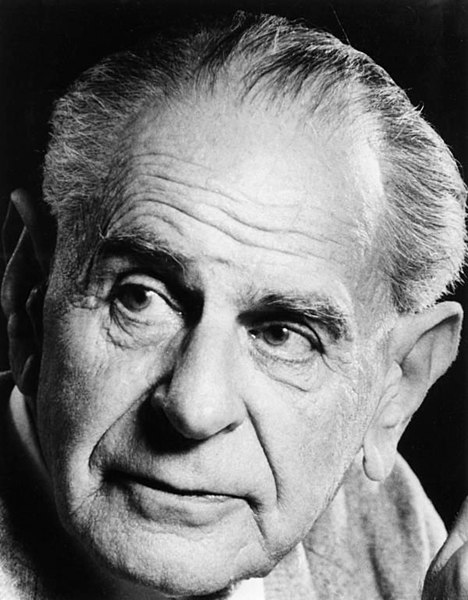
Popper's reasoning would prove to be the gold standard in scientific research and practice! He was not himself an experimental scientist: he was not a physicist, or chemist or any such practitioner of the scientific method, but as a philosopher of science, he did much to help establish science as a reliable institution in society. His theory of falsifiability can be summarized by stating that any scientific theory must be defined by the presence of all three of the following terms: testable; refutable; and falsifiable.
It is important to note that earlier, we made the claim that God, himself practices science. In evaluating that claim as we soon do in the coming sections, we must acknowledge that God's superiority places him in a different category. The difference is not in what constitutes science but in the perspective from which it is conducted. Scripture states:
'For my thoughts are not your thoughts, and your ways are not my ways,' declares Jehovah. 'For as the heavens are higher than the earth, so my ways are higher than your ways and my thoughts than your thoughts'Isaiah 55:8 & 9
Hence, the proper perspective is imperative. Just as human theories must be testable, refutable, and falsifiable, so too Jehovah's. The exception, is that Jehovah's theories are not guesses! They are accurate accounts that time will bear out as truthful once mankind's scientific prowess has caught up sufficiently to be able to accumulate observational data and provide proofs through experimental evidence. Before the invention of the telescope, it was impossible to prove that the other planets did not revolve around the earth, but as soon as it was invented, that was one of the first proofs that man's newfound technical prowess furnished. Similarly, before the telescope, it was impossible to prove that the earth was suspended in the air and was not resting on turtles (or any other scientific falsehoods). However, once the telescope was available to truth seekers, within 178 years the question which had fascinated mankind for millennia was irrefutably proven, once Isaac Newton published Principia and proved once and for all, that all the planets were suspended in the air with no physical scaffolding, but were instead held in their orbits by the mutually attractive force of gravity between them and the sun. Mankind's abilities had reached the threshold where they could finally prove the accurate description of the earth's position in space, as God had outlined in the Bible some 3160 earlier, in 1473 B.C.E. That scripture was penned by Moses - the very first writer God inspired to write a part of the Bible. In all the scientific theories God inspired to be recorded in his word, we will find the same pattern. Jehovah makes a prediction and many millennia later, mankind's abilities to observe, measure and verify catch up to the prediction. In all such cases the predictions have always been verified and - never falsified! That perfect record continues today as you will soon discover for yourself.
Jehovah's methodology is the riskiest form of all scientific prediction, for in giving detailed descriptions of scientific phenomenon, Jehovah makes many predictions - only one of which must be falsified, for all the rest to be disbelieved! If even one detail in any of his predictions is proven to be false, everything else is falsified with it. There is no wiggle room in Jehovah's practice of science - no room to vary the interpretation. No, "Oh I meant this ... and not that." It should be clear to all who are paying attention that God would only expect his predictions to be verified once mankind's abilities had caught up. That means any who had wrong interpretations before God's time to verify the prediction arrived, where not acting on his behalf. In other words, the Catholic Church's wrong interpretations of scripture over many centuries have nothing to do with God himself. God not only carefully calibrates when his predictions will be verified, but he also designates whom he will use to do so!
The Truth Cuts Both Ways
What may not be easily apparent at first glance, is that God has constructed the universe in such a way that all theories will be verified or falsified at Jehovah's appointed time. The very features of false theories that make them compelling in the absence of man's technical capacity to falsify them is what becomes their Achilles heel when such a time does arrive!
Let us take heliocentrism as an example. Without the ability to disprove the theory, it's crystal spheres that held all heavenly bodies in place and allowed them to orbit the earth sounded grand, sure-footed and imperious. The unanimous consensus between both the false scientists and the Church made the theory impregnable for more than 1500 years. But what happened as soon as the telescope was invented? Those same features, which were the pillars of the theory: the immutability of the heavens; perfect circular orbits; heaven and earth being controlled by different forces; the mystical metaphysical region inhabited by prime movers; and how prime movers controlled the movements of the heavens from such a metaphysical region all came to be the biggest flaws of the theory(ies) - once observational data and empirical evidence was obtainable! See how many dominoes fall from reasoning on just one piece of evidence? Let's take comets as an example. Once Newton had proved that the flight path of comets could be predicted by universal gravitation, it falsified the existence of the invisible crystal spheres because the path of the comet cut across the orbits of different planets. Secondly, universal gravitation, proves that only one force controls both the motions in the heavens and on earth. Third, the path of comets is not a perfect circle, but an ellipse, as are the orbital paths of all planets - though less eccentric (less egg-shaped). Fourth, the heavenly bodies are not smooth spheres, but they have topographical features (i.e. mountains), just like the earth. The moon for instance has craters, which are caused by meteors crashing onto it's surface. A sixth flaw: the guess about the existence of a mystical, metaphysical region was not based on any evidence, it was added ad-hoc, as a feature of heliocentrism, because the framers of the heliocentric model had to account for what made all celestial bodies move. That is why its inhabitants were called prime movers! Those are six falsifications from just considering the implications from a clear understanding of how one entity in the solar system works. But there is a deeper truth. Such falsehoods are not innocent guesses about how the universe works, that just happen to have been proved false by man's forward march of scientific progress. The Bible describes them as the "ungodliness" and "unrighteousness" of men who "are suppressing the truth in an unrighteous way." (Ro 1:18) How can we tell? Following is one easy way to tell.
Question, since the explanation of gravity was published in 1687, almost 350 years ago, why is the Catholic Church and the Western world at large still holding on to the concept that God is metaphysical, mystical, and transcendent as defined earlier! Once the explanation of universal gravitation became widely accepted, all components of he heliocentric worldview should have been abandoned with it. Why have these three ideas survived? Take careful note of that question, as it's answer plays a central part in the unfolding of the Greatest Story Ever Told!
Understanding the Fundamental Law of Evidence Profiles
Without proper experiments I conclude nothingJohannes Kepler
It doesn’t matter how beautiful your theory is, it doesn’t matter how smart you are. If it doesn’t agree with experiment, it’s wrongRichard Feyman
See now the power of truth; the same experiment which at first glance seemed to show one thing, when more carefully examined, assures us of the contrary" Galileo Galilei
What were these top notch scientists trying to get at in the above quotes? The kernel of truth they were trying to communicate is that trusting our eyes and first assumptions is not good enough in scientific practice. To establish the truth we must assess situations at a level deeper than mere appearances, a level which is only verifiably attainable through experiment. Indeed, Richard Feyman went as far as stating: "Progress in science comes when experiments contradict theory."
All entities in nature are extremely complex. Everything. From the simplest cell to an atom. They are layered in complexity and pulling back one layer of complexity only serves to reveal another deeper, yet more complex one. When around the time of Aristotle, another Greek philosopher, Democritus (460B.C.E - 370B.C.) coined the term 'atom,' he was imagining the smallest particle in existence, something that could not be reduced to smaller constituents, but was itself the smallest building block of nature. Over the last 22 centuries humans have learnt that that quest is much harder than simply defining the concept. Once, we could experiment on atoms, we discovered they were made of smaller building blocks such as the electron and proton. That in turn led to further building blocks on an even smaller scale. The point is, even when we try to define the most fundamental building blocks of nature, we realize that it is composed of layers and layers of complexity and the only way we discover such truths is through experimentation, not intuition. That's what Galileo meant when he said: "There is not one effect in nature, no matter how small, that even the most speculative minds can fully understand." It is for this reason that relying on our perspective will never lead humans to the truth. Arriving at knowledge and understanding must be mediated by the litmus test of experiment! Without that step, there is no science. Galileo made the point thus: "They who depend upon manifest observations will philosophize better than those who persist in opinions." Feynman agreed, stating: "The test of all knowledge is experiment." And again...
First you guess. Don't laugh, this is the most important step. Then you compute the consequences. Compare the consequences to experience. If it disagrees with experience, the guess is wrong. In that simple statement is the key to science. It doesn't matter how beautiful your guess is or how smart you are or what your name is. If it disagrees with experience, it's wrong. That's all there is to it." Richard Feynman
What does this mean regarding the synthesis of the Bible and science? Is it possible for two seemingly divergent sources of knowledge to agree on any matters of reality? Yes! But more than agreeing on just some, they have to agree on all matters, as the slightest divergence would falsify the errant party. Nature cannot be falsified as we are living in it, and the Bible says of itself: "Indeed, it is easier for heaven and earth to pass away than for one stroke of a letter of the Law to go unfulfilled." (Lu 16:17) The Bible, by necessity must prove correct in every aspect of every scientific theory it proclaims! Galileo was of the firm conviction that true science and true religion infact had the same goal, glorifying God!
The prohibition of science would be contrary to the Bible, which in hundreds of places teaches us how the greatness and the glory of God shine forth marvelously in all His works, and is to be read above all in the open book of the heavens" Galileo Galilei
His sentiment is clear, and not unique! His contemporary Kepler, who had wanted to be a theologian, was instead, at the age of 22 recommended to be a mathematics teacher and was overjoyed at discovering that his new career was just as fruitful an avenue for bringing praise and honour to his God and Creator:
I had the intention of becoming a theologian...but now I see how God is, by my endeavors, also glorified in astronomy, for 'the heavens declare the glory of God
And again...
Since we astronomers are priests of the highest God in regard to the book of nature, it befits us to be thoughtful, not of the glory of our minds, but rather, above all else, of the glory of God" Johannes Kepler
There are enormous pitfalls though! the premature claims on the part of some as to what the scientific meaning of Bible verses was. And attempts have been made over the years to use these empty assumptions to bring disrepute to the Bible. Again it is Galileo who explains both why the opportunity for such a pitfall exists:
It is necessary for the Bible, in order to be accommodated to the understanding of every man, to speak many things which appear to differ from the absolute truth so far as the bare meaning of the words is concerned
And how the Bible's misinterpretation arises ...
It seems to me... that the Holy Scripture cannot err, and that the decrees therein contained are absolutely true and inviolable. But I should have in your place added that, though Scripture cannot err, its expounders and interpreters are liable to err in many ways; and one error in particular would be most grave and most frequent, if we always stopped short at the literal signification of the words" Galileo Galilei
In the two above-quoted statements Galileo makes it clear that the Bible, directed as it is, at humble people - who often have low levels of education - of all races and backgrounds, is written in such a way as to have the broadest appeal to them all (1Co 9:19-23). There are at least two more factors that merit consideration. God does not extend the value of the Bible's message to the wicked, this means the key to unlocking its message is humility and a righteous disposition, not intellectual capacity (Ps 1:1-4; Mt 7:6). This principle means scripture is made only for those who will sincerely take the time and put forth the effort to try and understand what they truly believe to be the word of God! (Ac 17:11; 1Th 2:13) Lastly, the two previous factors mean the Bible requires exertion: physical, mental and emotional from its readers before they can grasp the meaning of its words (Ro 12:2). This feature of God's word means it uses general language that has the broadest range of application. For this reason it has more layers than the impression we may get upon first reading. Indeed, it is a book which is understood only through deep meditation and vigorous exertion of all our faculties, including our mental faculties (Lu 11:8,9; 13:23,24). A clear understanding of the above-mentioned truths meant Galileo knew that to understand the scientific explanations of the Bible would require a deeper reading of the Bible than a casual perusal would produce. That is what his statement: "...one error in particular would be most grave and most frequent, if we always stopped short at the literal signification of the words." In other words, taking the Bible only literally, and not digging deeper: is stopping short of its true message. There's nuance. As such, a prerequisite to understanding the knowledge of God is to dig deeper than mere appearances, and with this, the Bible agrees: likening the uncovering of precious truths to digging for treasures:
...If, moreover, you call out for understanding itself and you give forth your voice for discernment itself, if you keep seeking for it as for silver, and as for hid treasures you keep searching for it, in that case you will understand the fear of Jehovah, and you will find the very knowledge of GodPr 2:3-5
Moreover, Galileo also showed the way to resolving the seeming incompatibility of science and scripture. The key he said was not to start with the often poetic expressions of the Bible but to investigate the facts through experimentation, because only in the presence of evidence can synthesis between the Bible and science be achieved. Try and get the sense of his conviction through the following series of quotations:
I think that in the discussion of natural problems we ought to begin not with the Scriptures, but with experiments, and demonstrations
and...
[Copernicus] did not ignore the Bible, but he knew very well that if his doctrine were proved, then it could not contradict the Scriptures when they were rightly understood
and again...
See now the power of truth; the same experiment which at first glance seemed to show one thing, when more carefully examined, assures us of the contrary" Galileo Galilei
The core conviction he had was that: "... we ought to begin not with the Scriptures, but with experiments, and demonstrations." Why, because as he so plainly states elsewhere: the language of the Bible can so easily be misinterpreted! What he was sure of, and indeed what he was sure Copernicus himself, knew well, was that once, the scientific experiment and demonstration had resulted in empirical evidence, and observational data, such evidence and data would also harmonize with the words of Scripture, once those words were correctly understood. That to Galileo was the "power of truth!" For instance the often misapplied scripture found at Ecclesiastes 1:4 according to The Bible in Living English, "A generation goes and a generation comes, and the earth stands forever." This scripture was in ancient times used to try and prove the geocentric model of the universe. "The earth," the pundits would say, "stands forever." To them, this was undeniable proof that the earth was immovable, stationary and thus at the center of the universe. Of course a clear reading of the text shows that what was being contrasted in the scripture, is the transience of human life, against the permanence of the existence of the earth, not its coordinates in space. (Ps 37:29) Thus, contrary to all assertions by the Catholic Church, the verse had nothing to do with God's position on the debate between the heliocentric and geocentric models of the world system. As Galileo rightly said: "[Copernicus] did not ignore the Bible, but he knew very well that if his doctrine were proved, then it could not contradict the Scriptures when they were rightly understood."
the enlightenment
If the 1600s with Galileo Galilei, Tycho Brahe, Johannes Kepler and Sir Isaac Newton could be classified as the century of precision, experimentation, discovery and instantiating the scientific method, then the 1700s proved to be something altogether different. A new movement and attitude took hold mainly in France, and came to be centered around the intellectual circles of Paris. It's aim was to free the minds of men, so they could think for themselves.
Progress? ...
Based on the assumption that they could build on the tremendous advances made in the previous century, many intellectuals tried to spread the fearless spirit of "men of true science" that had been instrumental in gaining key victories for scientific truth. Recognizing the sacrifice, courage and strength of character it must have taken to stand up to the authority of the Church in trying to reveal ultimate truths, these intellectuals, perhaps feeling momentum was on the side of truth, made it their aim to inculcate these values into the populace of Europe through whatever means they had, including talks, journals, pamphlets, scientific academies, gatherings in coffeehouses and through any other means they could use to spread their influence. Among their chief goals was the separation of Church and State in an effort to curb the influence of the Church over the rational thoughts of men. Having apparently taken inspiration from the previous centuries' successes of reason over doctrine The Enlightenment movement, also known as the Age of Reason, soon dominated Europe. According to Wikipedia its:
... range of ideas centered on the value of human happiness, the pursuit of knowledge obtained by means of reason and the evidence of the senses, and ideals such as liberty, progress, toleration, fraternity, constitutional government, and separation of church and state" Age of Enlightenment - Wikipedia
Marked, by most scholars to have begun with the death of the French King Louis XIV in 1715, it was founded on grand statements made by leading thinkers of the previous century such as Rene Descartes': "Cogito, ergo sum" translated, "I think, therefore I am," a statement found in his influential 1637 publication Discourse on the Method. Wikipedia continues that
Many historians now date the end of the Enlightenment as the start of the 19th century, with the latest proposed year being the death of Immanuel Kant in 1804.... In France, the central doctrines of the Enlightenment philosophers were individual liberty and religious tolerance, in opposition to an absolute monarchy and the fixed dogmas of the Church. The Enlightenment was marked by an emphasis on the scientific method and reductionism, along with increased questioning of religious orthodoxy" Age of Enlightenment - Wikipedia
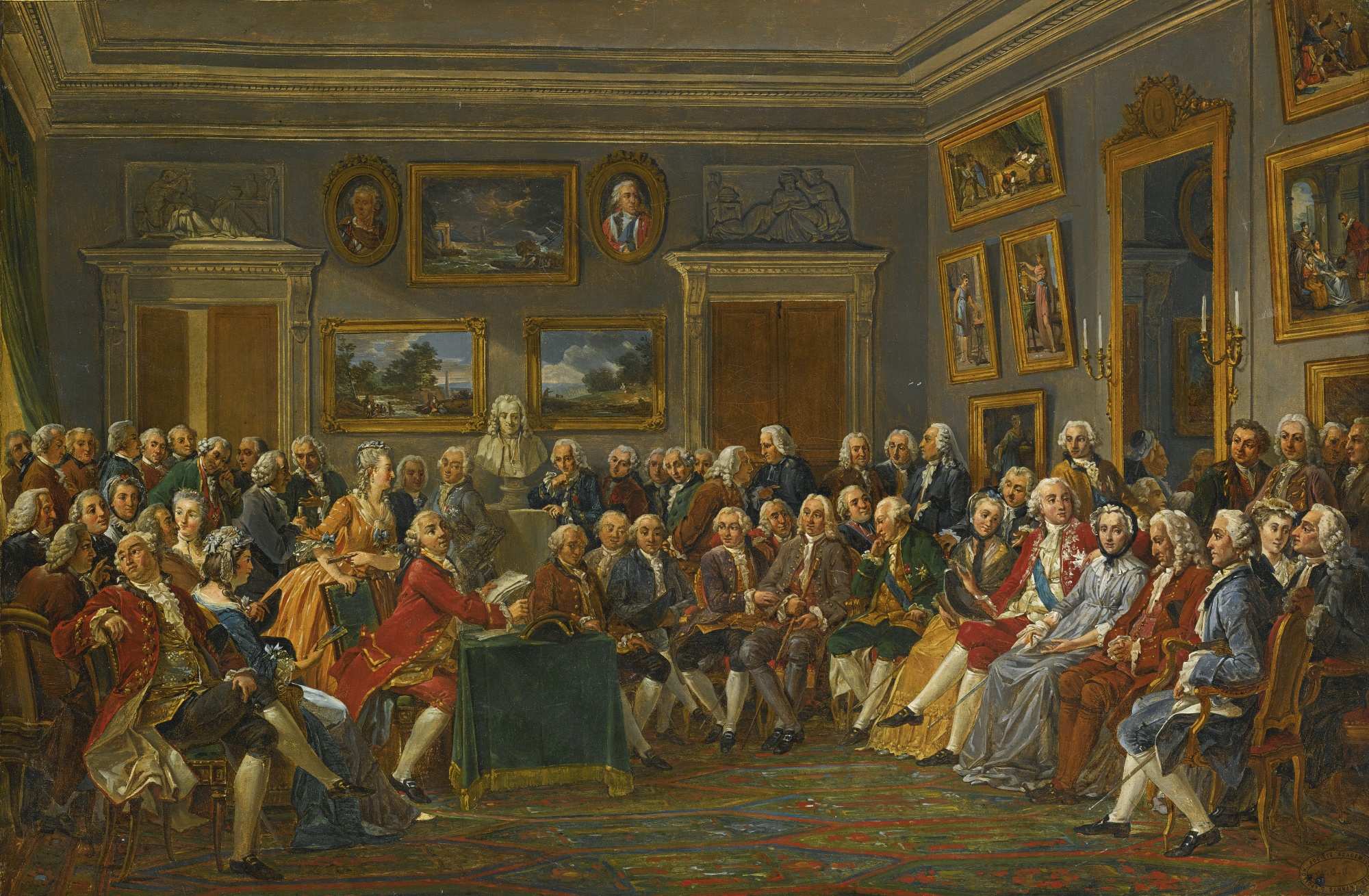
The Enlightenment was different to the all revolutions of thought that preceded it. For instance, the Renaissance, and the Scientific Revolution that preceded it were named not by the participants of those paradigm shifting movements, but by historians who after the fact - were trying to classify the momentous changes those movements ushered in. Not so with The Enlightenment, its adherents had a firm goal in mind and there was widespread agreement about its aims, identity and the methodology of how to achieve it. Curious ... isn't it?
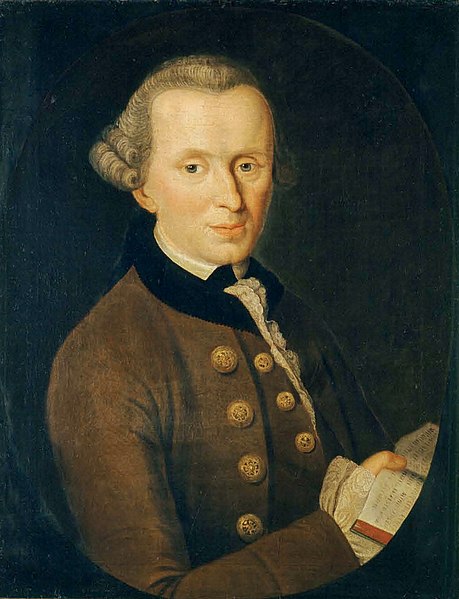
Immanuel Kant, coming as he did at the end of the Enlightenment, was one who perhaps, best summarized it. In the year 1783, a Prussian government official, who incidentally was also involved with the Church, one Reverend Johann Friedrich Zollner, had posed a question to the intellectual community at large in response to an earlier letter of April 1783 by Johann Erich Biester that was entitled: Proposal, not to engage the clergy any longer when marriages are conducted. Many intellectuals had responded to make their case, but the most famous of these responses to Reverend Zollner belonged to Kant. In his essay entitled Answering the Question: What Is Enlightenment? Kant went about the task by explaining what he thought, the opposite of enlightenment, represented. His message follows as captured by Wikipedia:
Kant's opening paragraph of the essay is a much-cited definition of a lack of enlightenment as people's inability to think for themselves due not to their lack of intellect, but lack of courage. Kant's essay also addressed the causes of a lack of enlightenment and the preconditions necessary to make it possible for people to enlighten themselves. He held it necessary that all church and state paternalism be abolished and people be given the freedom to use their own intellect.... He argues that the immaturity is self-inflicted not from a lack of understanding, but from the lack of courage to use one's reason, intellect, and wisdom without the guidance of another. Kant argued that using one's reason is considered dangerous by most men and all women. He exclaims that the motto of the Enlightenment is "Sapere aude"! – Dare to be wise!" Wikipedia
Any honest review of current-day life will reveal a society deeply divided by incompatible ideologies. Contrary to the oft repeated claim that the Enlightenment ushered in a new age of free thought, what we see in our day - times largely shaped by this false narrative - are tribal dynamics. Instead of people thinking for themselves, what we witness, is that, more than ever, people depend on the consensus of their individual tribes to know how to answer. This is the lesson of cancel culture. It's effect: the legacy of so-called 'enlightenment,' is a one-step-forward, two-steps-backward dynamic that permeates society. Of course the danger, which most who participate in such mobs realize too late, is that it has no center. It's like a basketball team of 5 people who have an average height of 1.5m. On such a team, there may not be a person who meets that average criteria. There may by no one who is actually 1.5m tall! In society this translates to everyone feeling insecure about their position in the mob - since no one meets the criteria of the central or average figure. There is no authentic persona to point to. This produces relentless anxiety, which has become the all pervasive tell-tale signal of our times! Perhaps that's progress....
The thrust of Kant's message then, was not that people didn't have the intellect to interrogate the facts for themselves, but rather that many lacked the courage to do so due to influential Church dogma. That much was true! Unfortunately, in the secular world we live in, people have just replaced corrupted, apostate Catholic Church teachings, with corrupted apostate atheistic thinking of the majority of the scientific community. And they still, by and large, outsource the building of their belief systems to outside 'experts.' In our case, that means scientists. Is that progress?
... Or Regression & Debasement?
Be that as it may, the Enlightenment, did not produce the results that it hoped to. Instead of inspiring future generations to bold invdividualism, it served only to unmoore people from the traditions and institutions that had helped define their view of the world. Society was left without a social glue. It was the wrong solution, produced to solve a non-existent problem. By conflating the authority of the Catholic Church, with the proper worship due to God, it muddied the waters and made mankind, in general, think that divesting ourselves of a worshipful fear of the Creator was a desirable move forward for all mankind - progress. The only real change it engendered was to embolden people to make spurrious arguments, with bold conviction, as if there were any evidence to back them up. It's influence was to spread the bravado - with which etherists populated the consciousness of mankind - to the masses in general. Today people make all sorts of unfounded, evidence-free claims, without so much as a hint of irony. The tenets of the Enlightenment, have led to the current situation, where people feel emboldened to assert that men can become pregnant! Is that "Dar[ing] to be wise?"
Instead of inspiring free, individual thought, it has spawned the worst kind of groupthink! Today, the only factor to consider, in which side to take on an issue, is not based on a consideration of the merits of the issue at hand, but to align oneself on the side of my tribe. For this reason, no matter how ridiculous and patently and demonstrably false claims may be, people feel free to assert them, as long as they are assured that that is the prevailing position of their tribe. Note, that I keep referring to peoples feelilngs in coming to such decisions, and not their thinking abilities. That is because, people are not using their mind to compute the answers, only their emotional filters. Every generation, feels they represent the bleeding edge of human development, and wrongly label their age as modern. This is false! You will also notice that I never use that term to refer to our present time, preferring current, or another relevant term instead. 'Modern' gives the impression that the current generation is somehow more advanced than what came before. This too, is false! Mankind is getting more and more debased, not the other way around. Our institutions are failing because they have rotted to the core. We are not, as the narrative goes moving inexorably toward a golden age. Do you feel like you are in a golden age? All this degrading of the quality of human life - not to be confused with standard of living - has its foundation in the so-called Enlightenment! Progress? Do you feel secure? Do you feel the world is on the verge of a dawn of a golden age? Do not confuse quality of life, with standard of living. Does your iPhone make you feel more or less lonely? Ask a teenage girl, for the real answer. The cost of such so-called progress has been the breakdown of the human condition. And people willingly participate for fear of being the next target. We are in a quagmire, that mankind has no idea how to extricate itself out of. Arthur Schopenhauer summed up the fealty, with which most people will succumb to the mob in the following words:
There is no opinion, however absurd, which men will not readily embrace as soon as they can be brought to the conviction that it is generally adopted" Arthur Schopenhauer
Pregnant men anyone? ...