
Electromagnetic Radiation & the Genius of Michael Faraday
No one can discuss light, without mentioning the name of James Clerk Maxwell. But before we talk about him, we must attend to some phenomenal forerunners. Especially one who was far more instrumental in defining electromagnetic radiation, than Maxwell could ever hope to be. This gentlemen almost single-handedly developed the whole field. Maxwell, merely helped formalize it into equations. As surprising as it may sound, the speed of light was calculated before scientists knew what light was. By the time Maxwell would contribute to the subject with his pivotal work, the speed of light was comfortably known to fall within a very narrow range. The tale of light and the interconnected discoveries that led to unifying different strands of evidence about 'light,' 'electricity' and 'magnetism' into one overriding theory about electromagnetic radiation, that is, how light is composed of alternating electric and magnetic fields - is a fascinating one. We pick up the narrative in 1826. In that year a pioneering scientist named Mary Summerville who was an avid experimentalist, theorized in a paper published on 2 February 1826, that she had discovered how to use sunlight to magnetize needles. It had already been proven that current in a wire (electricity) could move a magnet. Taking both claims in stride then, we get a picture where we have three entities: light, magnets and electricity; and we have two declarations that claim to be able to prove that each of these three variables could be used to affect the others. The problem is that while Summerville's claims had not been proven, six years before she made them her fellow scientist, by the name of Hans Christian Orsted, had discovered how electric currents could create magnetic fields, establishing a connection between electricity and magnetism. Thus it was known factually, that two of the variables were somehow related to each other. As it turned out, Summerville's claims were never backed up by empirical proof and were in fact disproven, only three years later. As yet, the bridge between light and our other two variables, if it existed - lay hidden.
There are few men in the history of science who have had a greater effect on furthering the body of human knowledge than Michael Faraday. Yet, he was shunned by the academic establishment because they considered him uneducated, for he didn't have a formal education. This begs the question, what is education? Since, education is defined as the attaining of skill through learning, is a formal education, the only way to learn? If someone can think logically, and has a gift for critical analysis married to an insatiable desire for knowledge, and a nack for designing highly effective experiments, but they have developed such abilities independently of formal education, is such a person un-educated? How about the other end of the spectrum: where a person with no lateral thinking, or ability for critical analysis, who has gone through the tertiary system and is now accredited with various combinations of letters after their name, what of them - are they educated? You should know that the majority of scientists fall exactly into that second category, and they will never have any impact on adding to the knowledge base of mankind. Recognizing this: Elon Musk once advertised for top tier computer programmers and stipulated that they did not have to have credentials, only superior coding skills. Computer coding, is one of many fields where those who are self taught, often outperform, degreed individuals.

Michael Faraday - A True & Towering Genius
The next pivotal development on our journey came from a man of humble beginnings who was an unadulterated genius - Micheal Faraday (22 September 1791 - 25 August 1867)! Unfortunately, he was timid about publishing his scientific instincts, as he was well aware of the scorn with which the formally educated scientific community generally regarded him, for he did not have a privileged background. They viewed him as being hobbled by a limited scope in formal mathematical training, but nothing could have been farther from the truth. His mind was perfectly mathematical, what it was devoid of was the formalized jargon of mathematicians, with it's symbols and conventions. Lack of such formal training does not diminish a great mind, it only arrests its ability to communicate in such symbolism. Faraday once commented that such mathematical symbolism were "hieroglyphics," that he needed to have translated in order to understand the underlying arguments. His approach was exactly the opposite, he stated his arguments without adding the mathematical flourish. No less a mathematical mind than Maxwell, attested to the fact that Faraday's ideas - which were always published devoid of any mathematical proofs - were indeed mathematical in nature. Inability to express mathematical ideas formally, is different to not having mathematical ability. Maxwell - to his credit - kindly noted that about Faraday's talents!
First, some background developments.
Magnetism & Electricity
In 1820, Hans Christiaan Orsted (also spelled Oersted in English) showed that electricity could create magnetic fields. This discovery was highly significant, because it was the first to establish that there was a direct connection between electricity and magnetism. Oersted had placed a compass beneath a wire, and run a current through the wire. When he ran the current by connecting the open end of the wire to a battery, thus completing an electrical circuit, the compass moved, proving that electricity could move magnets. Five years after Oersted's demonstration, one William Sturgeon, was the first person to create an electromagnet. He accomplished this by wrapping wire around an u- shaped bar of iron. When he ran current through the wire, the iron bar became magnetized, hence the name 'electromagnet': a magnet that is produced through electricity. The following year, Faraday also learnt of Sturgeon's invention and quickly set upon trying to improve it, with great success - the details are unimportant, except to mention that Faraday's electromagnet was a circle, instead of an u-shaped bar. He also created two coils within the same bar: one on each half of the bar, separated by small margins, at 12 and 6 o'clock. His design allowed for a much stronger magnet due to the coils being more tightly packed, which generated more electricity, and hence a stronger magnet. He knew that electricity and magnetism were somehow deeply connected, and to prove it, he wanted to create electricity by using magnetism.
Before we continue with Faraday, we must touch briefly on a man whose contribution is so critical to subject of electricity that the official unit for electric current - the ampere, is named after him: Andre-Marie Ampere (20 January 1775 - 10 June 1836). I say briefly, because I will only be focusing on one contribution from him. Upon Oersted's discovery in 1820, the scientific community came to learn about this new feature of reality, and as always a race was on to try and understand it. And so it was that Ampere, set about trying to understand the relationship between electricity and magnetism. His experiments were centered around the effects two current carrying wires parallel to each other would have on one another. He found that if the current was traveling in the same direction, the wires would be attracted to each other, and if the wires were arranged in such a way that the current flowing through them was in opposite directions, then they would repel each other. He then formalized his findings by defining the principles of action that guided the outcomes of his experiments. He was an extremely devout and talented experimentalist! Wanting more than just the laying down of principles, he aimed his efforts at trying to find a physical understanding of how electricity is related to magnetism. Toward that end, he theorized that there must exist, an electrodynamic molecule! What would the value of such a molecule be? It would be the carrier agent for the forces that produced the effects he had documented! Please note his instinct, and observe the emerging pattern as we move from one scientist to another. People who are devoted to and good at experimentation, meaning they know not only how to practically engineer and carry out revealing experiments, but more critically, they know how to interpret their findings - always allow the facts to lead them to correct and logical conclusion - unlike Priestley and his refusal to believe in oxygen. Such people are always looking for concrete explanations to phenomena of nature. That means they always expect to find a particle that is tied to the forces they are investigating. Whereas, others have the direct opposite instinct of always assuming the behaviour under question is the product of an ether, whose characteristics they feel free to define without any experimental evidence for the existence - or behavioural dynamics. We focus on Ampere, only to make this point. He was a Physicist, who sought answers in the real world, not an Etherist (new word), who indulged in fanciful ethers, instead of carrying out physics based experiments that could shed light on the forces and the accompanying particles that act as their carrier agents. Of course, the "electrodynamic molecule" whose existence he was sure of, proved to be the electron! He was a physicist, not an ether obsessed metaphysicist! He practiced Science; not Scientism (false science)!
Returning to Faraday, we rejoin his narrative as he thinks of ways of accomplishing his goal of creating electricity from magnets. Through many failed experiments, he came to the idea of attaching one side of his two-sided electromagnet to a battery, meaning it would work as per normal - as Sturgeon had used it, but it was what he did with the second part that produced the interesting result. In a bold move he combined Sturgeon's experiment with Oersted's by placing a compass under the second coil, that was not part of the electrical circuit. In this way, if the compass moved it would show that an electrified coil could produce electricity in a second unattached coil through magnetism. The experiment was a success, but, as I said earlier, with some interesting observational notes. His compass only moved when Faraday was attaching and disengaging the battery source. The time during which the battery was attached had no effect on the compass. I will let Joseph tell you Faraday's conclusion,
Faraday repeated this experiment many times and he found he created current in the second coil, when the first one was charging up or discharging, but never when it was flowing steadily - even when it had incredibly large current. In other words: an electromagnet only creates current in another coil, when the magnetic field was changing! If its strength is steady, nothing happens" Kathy Joseph
He didn't know it at the time, but Faraday was halfway to his ultimate goal, for as Joseph puts it: "Faraday had managed to create electricity with electricity, but he still hadn't managed to create electricity with a magnet." Of course, he continued non-stop with his experimental efforts, but what was really necessary for a true breakthrough was a new approach. And this, Faraday hit upon when he started approaching the experiment from the opposite direction. Instead of a moving current, producing a magnetic field, what would happen if a moving magnet was brought into contact with coiled wire without a battery source? This idea might sound tame, in light of what is now known about electromagnetism, but within the knowledge framework of his time - this idea was truly out of the box thinking! Think for a moment what his premise was. There is no electrical current in sight. I am going to take coiled wire (to increase the effect - if any), just like I did in improving Sturgeon's electromagnet, then I am - by merely continuously moving a strong magnet within the coil of wire - going to create electricity! I will add a compass between the two ends of the coiled wire, to measure any electrical current that may be produced - as per normal. This is exactly what Faraday planned. That was the experiment, and ... it was a phenomenal success! Faraday, had at last created electricity by using only magnets. There were some other successful experiments that Faraday conducted, which I will not mention, but I include Joseph's summary of his discoveries:
He created current in a wire if he moved the coil towards, or away from a strong magnet; if he moved a magnet towards, or away from a coil of wire; or if he increased or decreased the magnetism of an electromagnet, near a coil of wire" Kathy Joseph
Faraday, now had the weighty task of explaining the mechanisms behind the dynamics he had seen. It had been known for a while - centuries - that sprinkling iron shavings around a magnet, produced strange patterns. The genius of Faraday was to again combine two separate pieces of evidence to form a coherent whole - the big picture. Obviously, since the iron filings are small pieces of metal shavings, they can be moved by magnets. Faraday, understood that the iron filings were arranging themselves into said patterns, because of unseen forces created by the magnet. In his scheme, he imagined that all three of the entities he had been testing: electromagnets; current carrying wires and bar magnets, had one thing in common: they all had what he called "lines of force," surrounding them, of which, the dynamic behaviour of the filings was a manifestation. The patterns, that the iron shavings arranged into was determined by the geography of the invisible lines of force. It was simply a visible tracing out of the invisible reality. But he went further. So far, what I have expressed is merely a description, not an explanation. An explaining goes further than a mere description, because in addition to details, it provides clarification for how the described parts function together! And that is the important part!
Faraday, explained that these looping lines of force that emanated from all three of his tested entities acted differently under different situations. For instance, by drawing what the lines of force look like for the positive end of a magnet and what they looked like for the negative end, he was able to explain why two negative poles of a magnet repel each other, because their lines of forced are closed to each other, like two fists bumping against each other, but the lines of force between a north and a south pole connect, like when you hold your hands in front of you with your fingers touching. Connected lines of force allow for attraction. Closed lines of force produce repulsion, and the more lines there are, the stronger are the forces involved. This was 1831, and Faraday had just discovered magnetic and electric fields! Shortly thereafter, in 1832, Faraday innovated another leap forward for electricity, for up until now, his achievements were limited to creating electricity only temporarily, with the use of magnets. You will remember that current was induced, only when the magnet was in motion - back and forth - within the coiled wire. That meant, whenever the magnet changed direction, there was no current. His next task was to create continuous electricity, the way a battery does - using magnets. He realized, to generate continuous current, he had to find a way to generate continuous, uninterrupted motion. The easiest and favourite way for scientists to do that, is through a wheel. He then decided to use and refine an invention of another scientist, and published his successful results in the same year. In this latest innovation, Faraday had created what would become the world's first electric generator. And while that is important, what is of higher importance to us is the underlying understanding his experiments and inventions were giving him of the nature of electricity, magnetism and soon ... light! You will notice a distinct pattern in Faraday's thinking: he uses his last success as a springboard to new successes. We will next discover how he kept adding more and more variables to his successful experiments to build an in-depth knowledge and understanding of Electromagnetism as a whole.
In 1945 the brilliant Lord Kelvin, then only 21 and just starting out on his scientific studies and career (then, still known as William Thomson), asked Faraday about the possibility of him conducting an experiment that included all three of our variables of interest: light, electricity, and magnetism. Let's break down Thomson's request into its three components so we can fully grasp its significance. We will take each variable in turn, starting with light. Light as we now know, is composed of alternating electric and magnetic fields. These fields oscillate at alternate phases and the phases are at right angles to each other. Normal light, from the Sun, or a candle has two such fields: an electrical field, which then creates a magnetic field in a plane that is 90 degrees to itself. So far, so good. Now we introduce the dynamic of polarization. Polarization is something many of us are familiar with, for instance in our sunglasses. It just means some of the light is let through a filter - such as the lenses of our sunglasses - and some is blocked. The question is how? There are various ways to polarize light. For our discussion we only need to cover two: polarization by reflection, and polarization by refraction.
Light, Polarization and Brewster's Angle
Think of a ray of light that is approaching - at some angle - a flat surface that is parallel to the ground. The lightray has two planes of movement that are at 90 degrees to each other, like the x and y axis on a graph. The planes are described as being perpendicular (the vertical y-axis), and parallel (the horizontal x-axis that is most parallel to the ground). So the perpendicular field is moving up and down, and the parallel field is moving left and right. These movements represent the directions in which the fields are vibrating. When the incoming ray (called an incident ray) hits the surface, it splits into two portions. The two components that the lightray is split into are reflection and refraction. We all know what reflection means; refraction on the other hand, means instead of bouncing off the surface, the second component of the split lightray goes into the surface. Refraction is when a beam of light passes from one material into another material* If the surface is an opaque material, the refracted ray is absorbed. That's why tar roads get hot in summer. If the surface material is transparent, the refracted ray is transmitted: it goes right through the material. That's why we can see through windows, because the light is transmitted through the clear glass. Depending on the angle of incidence, the reflected light is polarized, which means it loses one of its directions of vibration, and we can easily determine which direction of vibration, or axis of movement it will lose. The direction of movement that is parallel to the surface will be retained and the direction of movement that is at 90 degrees to this, i.e. perpendicular to the surface will be absorbed or transmitted depending on the whether the surface is opaque or transparent. Think of it like swinging a pick axe into the ground, versus making a stone skip on water by throwing it hard, parallel to the body of water. The pick sinks into the ground (refraction), and the smooth stone bounces on the water (reflection). So the orientation of the light that is most heavily polarized is? ... Parallel. The light that bounces, is the one that acts like the stone and not like the pick-axe. Brewster's angle produces 100% horizontally (parallel, i.e. bouncing) polarized light.

Above, we have learned more about electromagnetic waves, specifically how they are formed at right angles to each other. In Figure 42, both the dots and the arrows represent planes that are at right angles to each other. When you see an a line with an an arrow at either of its ends, that represents waves that are moving in the plane of the screen you are reading this on. When you see a dot, that arrow has been turned 90 degrees, and one of those arrows is now coming directly towards you, while the other end is moving away from you. That's what the dots represent. In the incoming incident ray, both planes are represented equally, because the incident ray is unpolarized. In contrast the rays to the right of the dotted line are polarized to different degrees. Since, the reflected ray is totally polarized, it only reflects one plane.
Now think of the different angles that the incident ray could have: from nearly parallel to 90 degrees (perpendicular to the surface) - like sunrays that come from directly above us at noon, and all the angles in between. The percentage of the reflected rays that are polarized depends on the angle, of the incident ray. Starting from 90 degrees (the y-axis), and working our way down to the x-axis, the percentage of the reflected rays that are polarized starts of low, let's say 10%, then moves to 20% and keeps gradually increasing as the incident ray moves away from 90 degrees. At some point (it is different for each material and also depends on whether or not the material is transparent or opaque), you reach an angle for the incident ray, at which the reflected ray produces 100% horizontally polarized light. This angle is known, quite factually, as the angle of polarization, because it produces reflections that are 100% horizontally polarized - for reasons, you should now be able to explain, quite well (think pebble vs pick-axe). When the surface is glass, this angle is 56 degrees for visible light; in water the angle changes to approximately 53 degrees. Below, please find and example for glass.
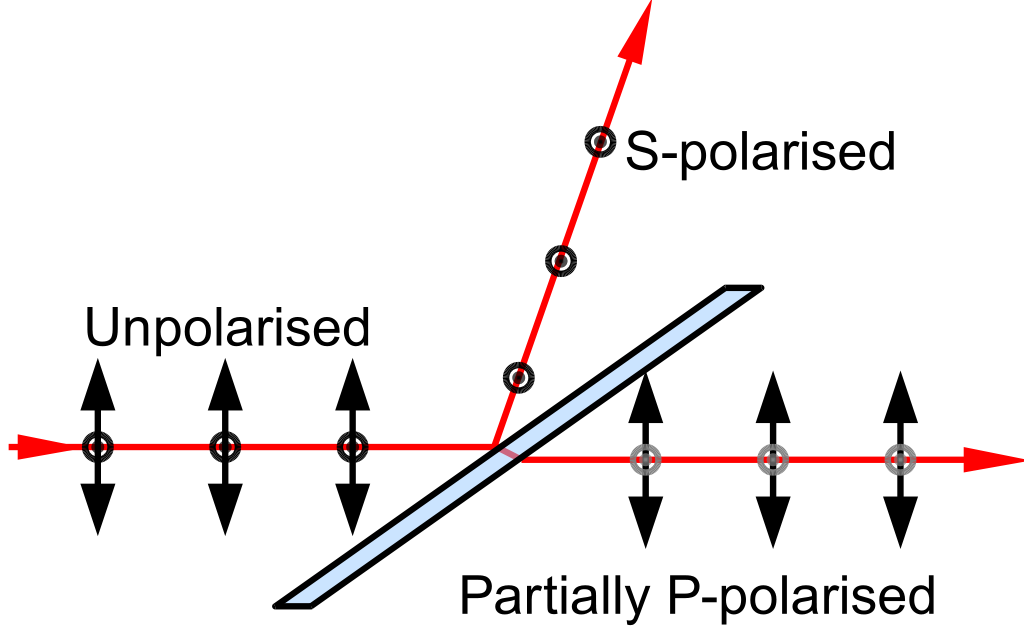
Having studied how this effect is produced, we can now examine Figure 44 below, to see to see a photo that demonstrates one of the practical, everyday uses of this technology.

EXPLANATORY NOTE
By using Brester's angle to cut out glare - which is what our sunglasses do - the window on the right allows us to see the contents of the room, and not be blinded.
If we continue with our descending angles of incidence, as we dip below the angle of polarization, the percentage of polarization in the reflected rays starts to decrease from 100% and gradually goes down the gradient: to 90, 80, 70% and so on, as we approach the x-axis, or zero degrees. So the dynamics either side of the angle of polarization, which produces 100% polarization mirror each other. Obviously the percentages don't follow a law of increments of 10, those I just numbers I plugged in, for illustrative purposes. This angle, the 'angle of polarization' is known as Brewster's angle, after Sir David Brewster, who whilst he wasn't the one who discovered it, was the physicist that, in 1815, properly defined it, proving that it was a function of the refractive index.
William Nicol and the Polarization Prism
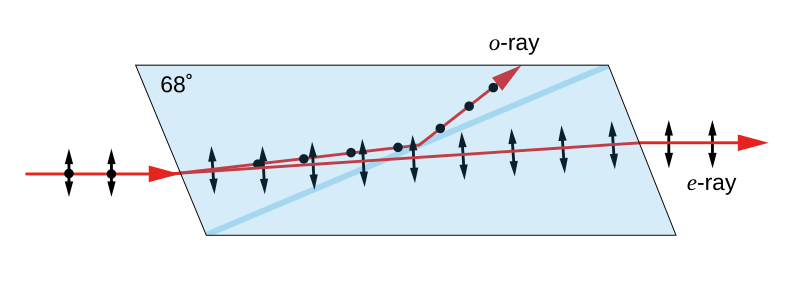
We add one more variable to our scenario of light hitting a transparent surface: Iceland crystals. Iceland crystals, are a rare form of a mineral called calcite, and they have the very unique property of producing double refractions. That means upon entering an Iceland crystal, the incident lightray is refracted into two beams! In other words, when you look into an Iceland crystal, you see two images, instead of one. Humans can't tell the different types of polarization apart with just our eyes, hence, we see two images. Now, in our previous example with Brewster's angle, the reflected light beam was 100% polarized, but the refracted beam was left more or less unpolarized, so that to a large extent, it resembled normal light. However, in an Iceland crystal, both of the refracted beams are polarized: one is polarized perpendicularly to, and the other parallel to the surface of the Iceland crystal. That means a perpendicular polarization filter can completely block the perpendicularly oriented ray, with the same being true for a parallel polarization filter and the parallel polarized ray. This is what Nicols managed to do with the invention of his prism. Most polarization filters are thin sheets of plastic, but Nicols' filter is a prism, similar to the prisms used in spectroscopy, because he took an Iceland crystal and cut into a specific shape - an angled rectangle called a parallelogram. He then cut the parallelogram into two equal triangles, after which he put glue between them, and pasted them back together. However the glue and the angle at which he cut the crystal were designed to reflect the most heavily refracted beam out of the prism, while allowing the less heavily refracted second beam to transmit through the Iceland crystal. In this way he got rid of one of the two beams: he created a filter.* (From: What is Light? How Faraday Dreamed of Electromagnetic Waves!) Which type of polarization is filtered out of a Nicols prism? The horizontally oriented beam is the one that bends more when it is refracted into an Iceland crystal, hence it is the one that is reflected out of the crystal, while parallel polarized light transmits through. Therefore, a Nicol prism blocks all horizontally polarized light! That wraps up the last component of the experiment Thomson asked Faraday about. Below, is an illustration demonstrating how it works.
Faraday Puts it All Together!
For some reason, it seems Thomson, later Lord Kelvin, had a habit of asking other people to conduct the experiments he was interested in. For whatever reason he asked Faraday to conduct this extremely technically difficult experiment. He couldn't have chosen a better candidate! After understanding that light, as a third and important factor, to the fundamental relationship between electricity and magnetism, Faraday, like Clausius before him, took the time to meditate deeply about the significance and consequences of these new facts. How exactly were light, electricity and magnetism related and what did that mean about the true nature of the universe? Specifically, how did light fit in to the picture. To unify everything in his mind, Faraday conducted a thought experiment. He knew about the macroscopic objects of interest: electromagnets, current carrying wired and bar magnets. It was obvious that light did not fit in to the picture on that scale. Going further into the invisible workings he knew of, about lines of force, he dared to reason that, both magnetic and electric fields had them. He decided that it was at this scale that light might be operative. His thought experiment was to not treat lines of force as some sort of ambiguous ether. He decided that both electrical lines of force and magnetic lines of force, were connected to charges. Thus, the charges were the source of the the electric and magnetic lines of force. In his mind, when one electric charge, for example, got excited for whatever reason, it's movement was communicated to the electric charge at the other end of the electric force lines it was connected to, through a wave-like disturbance, that traveled the length of the whole force line, until it reached the other charge and disturbed it by the exact same amount. He then extended the distance between the charges, so that the disturbance would have further to travel. The question was: "what exactly was this disturbance?" How could it be defined? His shocking answer was: the disturbance is what we call Light! Light, in Faradays mind, was the wave-like disturbance that resulted from excited electrons "plucking" force lines. This, of course, is the exact definition of light! To say Faraday was a genius is an understatement of the greatest magnitude. A strength of Faraday's, was his consistent ability to think logically, outside the box. Something that very few people, have been able to do throughout the history of man. A weakness: his timidity in communicating his ideas to the greater scientific community.
Of his latest, and most ground breaking idea, Faraday spoke, only under duress to an audience in 1846. His role was supposed to be limited to master of ceremonies, but when the speaker pulled out at the last minute, he was forced to step in, with a talk of his own. As he had not prepared any remarks, he spoke of his latest discovery - but prefaced his comments with the statement:
The view which I am so bold as to put forth, considers therefore, radiation as a vibration in the lines of forceMichael Faraday
He later added: "Even to myself, my ideas appear only as a shadow of speculation." Of course, his "shadow of speculation" proved, fundamentally, to be completely correct: if missing one or two details. If you have been paying attention, I am sure you will have a good idea as to the response, from the crowd. It's the same response people always give to new truths. Shocked horror, and self-assured indignation! Taking the lead, of course are always the cursed Intellectuals who find it their principle responsibility to always and everywhere, defend the older, orthodox way of thinking - from which they earn their livelihoods. One such Intellectual Yet Idiot, was an English mathematician named Sir George Airy, who had the lofty title of Astronomer Royal, only the seventh man to hold such a title. He quipped,
I can hardly imagine anyone who practically and numerically knows the electrical theory that accepts anything so vague and varying, as lines of forceSir George Airy
By the way, the scale at which light operates, explains why Mary Somerville's experiment to magnetize needles using light didn't work. Light operates at a different scale - the microscopic one. Her experiment, and those before hers, that had similar goals, where designed to achieve macroscopic results, using microscopic means! A mismatch that will always produce null results.
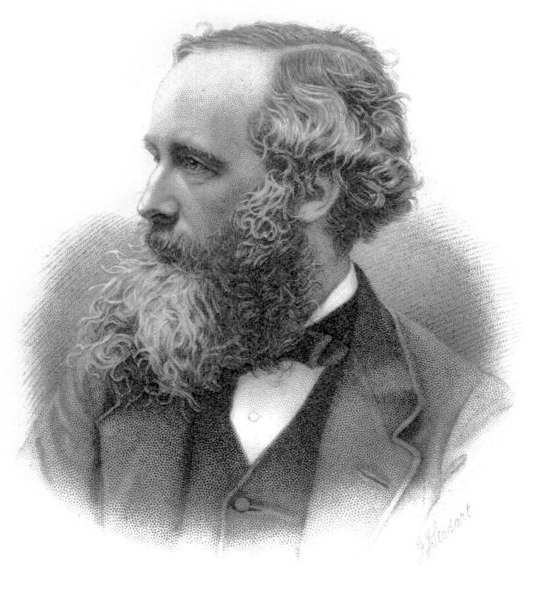
James Clerk Maxwell
We now come to James Clerk Maxwell (13 June 1831 - 5 November 1879) by fast forwarding eight years, to 1854. Maxwell, was then a young student who had decided to put all his energies into studying the exciting world of electricity. He had as a friend, Thomson, whom he asked for some advice about where he should start on his journey of knowledge acquisition. He put his options into two categories: should he study the mathematicians or Faraday, whose work contained no mathematics. Those stark choices well illustrate, Faraday's position in the physics establishment, it was him against the world. The fact that he, by himself, constituted an option also tells us about the magnitude of his achievements! The question Maxwell asked of his friend was a serious one, as choosing the wrong option would lead down a rabbit hole that might prove to be an expansive detour, if such study yielded no fruit. Thomson, who had - more than two decades earlier - asked Faraday to perform the experiment that contributed to the aforementioned chain reaction of paradigm shifts Faraday produced with seeming ease, responded decisively: read Faraday! Maxwell obliged, and soon was immersed in the writings of Faraday. To show you the stature of Maxwell, I will only tell you that Einstein hung the portraits of three scientists in his office: Newton, Faraday and Maxwell. It wouldn't be long before he produced something momentous.
Maxwell and Faraday proved to be two peas in a pod. Intellectual Yet Idiots, view mathematics as a language through which they communicate their lofty ideas. In reality, maths is a way to express the hidden, underlying relationships between entities that might, on the surface seem very different! For instance, Newton used mathematics to prove that the force that pulls an apple to the ground, is the same force that keeps the planets orbiting around the Sun. That is mathematics. In other words, there are two ways to be mathematical: by having the mathematical abilities to express hidden relationships in nature; or, having the out-of-the-box-thinking to see hidden relationships where others see chaos. BOTH approaches are mathematical. Maxwell had the former, and Faraday the latter - and both in spades! For this reason, when Maxwell pored over Faraday's experiments, observations, thinking and logic he pronounced that he found them secretly mathematical. He saw his task then, as to convert Faraday's secret math into conventional math! This he did, in a way that perhaps only a handful of people in the history of the world could have. In 1855 Maxwell published On Faraday's Lines of Force, the same "lines of force," that Intellectual Yet Idiot, Sir George Airy had derided as "vague and varying." Faraday approved of this work, only petitioning Maxwell to "translate them out of their hieroglyphics, that we might work upon them by experiment." By "hieroglyphics," Faraday, of course, meant maths. You don't have to look to hard, to see why both men's approaches were mathematical. While Faraday concentrated on studying mathematical relationships via experiment, Maxwell concentrated on mathematical relationships via formula.
One decade later, In 1865, after devoting many years to his intense work with electricity, and the study of Faraday's ideas, Maxwell was ready to shake up the world. Of all of Faraday's insights, the one that most people credit to him, was, in fact Faraday's concept, hatched almost two decades prior: the 1846 idea that light was a disturbance in the lines of the forces (forces is plural, take note) of electricity and magnetism. In his ongoing researches, Maxwell, at the behest of Thomson read the works of two German physicists, named Wilhelm Weber and Rudolf Hermann Arndt Kohlrausch, who had done pioneering work in experimentally determining the units of electricity and the units of magnetism. Take careful note of what follows.
The experiment itself, was straightforward. Weber-Kohlrausch, had stored a known amount of charge in a device called a "jar," which is a capacitor. Capacitors are "an electric circuit element used to store charge temporarily."* (Wordnik online dictionary.) The jar contained electrostatic charges of known quantity, as measured by a galvanometer (an instrument used for detecting the existence of, and determining the strength and direction of an electrical current - Wordnik). They then discharged the stored charges and carefully measured how long it took for electrodynamic units to produce the same value in a the galvanometer. Once the measurements were taken, they now had two values. This allowed Weber and Kohlrausch to determine the ratio between the values for these two units of electrical charge: that result is known as Weber's constant. Once, the measurement of the speed of light was truly and finally established, the Weber-Kohlrausch result proved to be more than 96% accurate. An amazing feat of experimentation for that time! Perhaps, more importantly, for the first time it could be proved empirically that electricity and magnetism were linked to optics - or light! Just to recap, Coulomb had given proof about how charges work, establishing the laws of attraction and repulsion that explained the dynamics between electric charges and magnetic poles, but without adding the final step of uncovering the nature of the link between them. Then Oersted showed that electricity could affect magnets. Thereafter Faraday proved that magnets could induce electricity. And finally, Weber-Kohlrausch used the fundamentals of electrostatic and electrodynamic or magnetic (since a dynamic electric charge produces a magnetic field) units to calculate a ratio which would prove to be an excellent first approximation of the speed of light. This, in turn for the first time, experimentally linked electricity and magnetism to light.
From here, things took a turn for the worse and science suffered a terrible regression as Kirchhoff and Maxwell decided to divert from the Faraday, Weber-Kohlrausch interpretation of the meaning of the speed of light, and decided to define it in their own way. Though Kirchhoff was just as guilty, we gloss over his error to focus on Maxwell's as it was his divergence from Weber and Kohlrausch's assessment that had a lasting impact on the science of electromagnetism. I will let Maxwell define his thinking for you himself. In his January 1, 1865 paper entitled A Dynamical Theory of the Electromagnetic Field Maxwell outlined the current state of affairs as achieved by the great minds prior to him; why despite their excellent records of producing stellar results, he found their work wanting; and the new direction, he was proposing as a remedy. I will break the quote into three sections so we can study each in turn. We start with his seeming adulation for the results thus far produced,
The most obvious mechanical phenomenon in electrical and magnetical experiments is the mutual action by which bodies in certain states set each other in motion while still at a sensible distance from each other. The first step, therefore, in reducing these phenomena into scientific form, is to ascertain the magnitude and direction of the force acting between the bodies, and when it is found that this force depends in a certain way upon the relative position of the bodies and on their electric or magnetic condition, it seems at first sight natural to explain the facts by assuming the existence of something either at rest or in motion in each body, constituting its electric or magnetic state, and capable of acting at a distance according to mathematical laws. In this way mathematical theories of statical electricity, of magnetism, of the mechanical action between conductors carrying currents, and of the induction of currents have been formed. In these theories the force acting between the two bodies is treated with reference only to the condition of the bodies and their relative position, and without any express consideration of the surrounding medium" James Clerk Maxwell
Maxwell states the current state of affairs: phenomena have been discovered and measured, with explanations provided. However the explanations credit only the interacting entities and the forces between them for the phenomenon, without making any reference to the medium in which these actions are taking place. He continues ...,
These theories assume, more or less explicitly, the existence of substances the particles of which have the property of acting on one another at a distance by attraction or repulsion. The most complete development of a theory of this kind is that of MW Weber, who has made the same theory include electrostatic andd electromagnetic phenomena. In doing so, however, he has found it necessary to assume that the force between two electric particles depends on their relative velocity, as well as on their distance. This theory ... is exceedingly ingenious, and wonderfully comprehensive [in] its application to the phenomena ... and it comes to us with the more authority, as it has served to guide the speculations of one who has made so great an advance in the practical part of electric science, both by introducing a consistent system of units in electrical measurement, and by actually determining electrical quantities with an accuracy hitherto unknown" James Clerk Maxwell
Here, he heaps praise on Weber, and his great achievements, agreeing that his theory is "exceedingly ingenious, and wonderfully comprehensive" Yet, he finds fault with it, as he goes on to write,
The mechanical difficulties, however, which are involved in the assumption of particles acting at a distance with forces which depend on their velocities are such as to prevent me from considering this theory as an ultimate one, though it may have been, and may yet be useful in leading to the coordination of phenomena. I have therefore preferred to seek an explanation of the fact in another direction, by supposing them to be produced by actions which go on in the surrounding medium as well as in the excited bodies, and endeavouring to explain the action between distant bodies without assuming the existence of forces capable of acting directly at sensible distances" James Clerk Maxwell
Trading Physics for Metaphysics
Maxwell speaks of the "mechanical difficulties ... which are involved in the assumption of particles acting at a distance." That is, how can particles effect actions at a distance. What is the mechanical agent that carries out the action? Instead of investigating, Maxwell deluded himself, by appealing to a universal fluid, as the source of the actions. He states, "I have therefore preferred to seek an explanation ... in another direction, by supposing them to be produced by actions which go on in the surrounding medium as well as in the excited bodies." There was no experimental evidence to support his new idea, nor has any ever been - or will any ever be - gathered, for the ether does not exist! He goes on to assert that he is "endeavouring to explain the action between distant bodies without assuming the existence of forces capable of acting directly at sensible distances." What justification did he have for that stance? None! Instead, the fact that he left the road that was producing discovery after discovery, to go on a fool's errand has much to teach us.
Some individuals leave difficult, complicated legacies. There are a few individuals in this blog, that fall under that classification, with Max Planck being another. In the case of Maxwell, the difficulty arises in assessing, the value of his overall impact: there can be no doubt that he was a mathematical genius of the highest order, who contributed greatly in that field; however that has to be balanced by the immeasurable damage he did to the world of physics, specifically thermodynamics, by siding with Boltzmann, over the masterful Clausius - for reasons you will understand in full, after a few more chapters. Additionally, he failed at following the already well established logical path in Electromagnetism. Instead he presumptuously started on a fool's errand: basing all his arguments on a non-existent ether. That is why, we can only rate his mind as "borderline brilliant."
We should be starting to see a clear trend about what science is, and is not! When humans encounter an unknown phenomenon, we investigate until we find its underlying principles and laws. In all cases where we have come to a deeper understanding of nature, we have done so by solving at least two of three critical puzzle variables: the definition; function; and mechanical agency(ies) responsible for producing the phenomenon. In other words, we want to clearly define what the phenomenon is, this step itself, takes serious investigation. Think of how foolish ancient concepts of what fire is, or what is the earth resting on seem to us now. That is because they formed theories on possible answers, without even investigating the mystery they were trying to define. Secondly, we want to correctly determine what entity or force, phenomenon are a function of. Without investigation, people often believe exactly the opposite of what is true. Think of the the daily perceived motions of the sun: for millennia, people were certain, absolutely positive that the sun was orbiting around the earth, when the reality all along, was the complete opposite! You can think of many ancient examples of this type of mis-assigned functionality. Lastly, having appreciated the proper definition of the phenomenon under question, and understanding what its effects are a function of, we want to identify the meditating agency. In other words, there is no magic, phenomenon are produced by forces and each type of force is related to a particle. Knowing either the particle or the force is only one half of understanding functionality. To truly comprehend nature we must know both the force and its carrier particle. This is what troubled Newton, he had figured out much about how gravity works, but like electromagnetic waves, his gravitational force was "acting at a distance," which as Maxwell puts it, presents a "mechanical [difficulty]." The universe is a mechanical place. Mechanical means pushing and pulling, and that requires contact, hence we cannot have forces that act at a distance, that is without contact! So Maxwell was right, for reasons I will let Dr Becky Smethurst explain:
It wasn't about measuring the speed of light anymore, it was about thinking what on earth is light - an electromagnetic wave - moving through, if it can move through empty space? Because waves need a medium to travel through, they need something to travel through. So ripples travel across the surface of water, a Mexican wave needs people to move around the stadium. Sound needs a medium to travel through. When it travels through air, it uses the molecules in the air to make them vibrate in order for that sound wave to travel. It's why in the vacuum of space, we always say: 'in space, no one can hear you scream.' But light obviously can travel through the vacuum of space, because otherwise, we wouldn't get light from the Sun! And so physicists, at the end of the 19th century were wondering what was the medium that filled empty space? And it was something that eventually became called: Ether" Dr Becky Smethurst - Why Can't Anything Go Faster Than the Speed of Light? (1:02-2:03)
Did you spot the problem? Maxwell wasn't wrong for questioning non-mechanical "action at a distance." Up until then, the only types of waves scientists had discovered: transverse and longitudinal all needed a medium to travel through. That is they were mechanical! So the fact that he noticed and then questioned why electromagnetic waves didn't have a mechanical nature was not necessarily bad scientific instinct, in and of itself, for he had come across a genuine scientific paradox. The exact kind whose resolution, always leads - to scientific revolutions. However, Maxwell stumbled. Instead of working hard, to experimentally establish the resolution to this perspective paradox; he wildly jumped to unfounded claims about the existence of an ether that could explain the paradox. In this, he made two mistakes! Firstly, Newton had already discovered a phenomenon, which did not work mechanically. By that I don't mean gravity doesn't have a mediating agent, it does - as will be proved later. I mean that Newton had shown that gravity acted through mass - not surface area, and mechanical phenomenon are based on surface area. Secondly: the folly of his approach was that instead of resolving the paradox, he, like Lavoisier before him, and many many others before him, turned to an Ether as the solution. It is critical that we see why this is wrong, and why it will always be wrong, no matter what the particular puzzle that we are trying to solve is! When people invoke an ether, it's never as a step to further investigation, it's always as a means of committing to no further investigation. Ethers, always come fully formed. We have covered enough ground at this point of our journey to have an historical basis for making that statement.
Consider any of the many discoveries we have gone through, and recall how they were incremental improvements in knowledge to which a large swathe of different physicists contributed to. This applies to the true nature of the solar system. It applies to the nature of gravity. It applies to spectroscopy. It applies to thermal dynamics. It applies to light itself, and it will apply to all future discoveries. However ethers are different. Whenever they are invoked, they come fully complete. Think of all the examples of so-called scientists appealing to ethers for various reasons, all of which we have covered. Their proposals always come fully formed. From Aristotle, who had a full explanation for what the ether did, how it acted, what it was made of, and where in the universe it was to be found, among other details. The same was true for Becher and Priestley and their Phlogiston. When Lavoisier proposed his new ether, the Carolic, it also came fully formed: He knew what is was - a fluid; how it acted, how much of it there was in the universe etc etc. No one ever asks, how do you know this? What experimental evidence do you have for these statements that you are proposing as facts? Of course, it makes tactical sense, that people who invoke ethers as explanations propose them fully formed. Remember, that ethers are a proud response to not knowing the answers. Ethers are invoked to fill a knowledge gap. As such, you cannot propose an ether without endowing it, with all the properties it would need to fill the knowledge void, otherwise what would be the point of invoking it be - in the first place?
The point is, when a scientist comes to the limit of his knowledge and realizes that there is more research needed to get a clearer picture, they must admit that, and commit to putting in the research needed to make further progress. Etherists, are just the opposite! When they reach such an impasse, they proudly refuse to admit to their own limits and instead start deluding themselves, and if successful, others too! Have you never played the game where someone hides something and as you search for it they say warmer, warmer, hot, hot as you get closer ... or colder, colder, cold - if you're straying from where they've hidden the object? Maxwell admits that the scientists who came before him were getting warmer and warmer. In fact, they were getting hot, only one mystery lay to be solved: how does light propagate without a medium? Instead of staying on that track, Maxwell, in his arrogance went to the cold side of the room and started on the most unproductive goose chase - invoking an ether! That is not how science progresses. When you come across a paradox, you have to grab ahold of it with both hands! The solution lies in the resolution of the paradox. In the case of light and why it could travel without a medium, the paradox obviously lay in the dynamics of light, itself! ANY solution that would focus on any variable other than light would not resolve the paradox. By focusing on the dynamics of the medium, or as he put it, by: "seek[ing] an explanation of the fact in another direction," Maxwell had lost before he started. The paradox is in the fact, therefore the resolution is also in the fact. Etherists seek to solve paradoxes by making them non-paradoxes. Whereas the solution to a paradox always lies in uncovering, and then understanding its true nature. Paradoxes arise from a low resolution understanding of reality. A paradox arises when we think two different phenomenon are one phenomenon, as when humans thought the explanation of the Sun's movement across the sky lay in it orbiting the earth. The truth was that to understand the Sun's daily movements across the sky, we had to realize that two separate dynamics were involved: 1) the earth moved around the Sun, and 2) in its daily motions the earth also rotated daily on its own axis. It was understanding these two variables that resolved the one paradox. Think also of heat. Understanding its dynamics meant appreciating redox reactions: two reactions were taking place, to produce the one effect.
Of course, as these paradoxes are resolved, on a larger scale, an opposing dynamic takes place, humans consolidate their knowledge and realize that phenomenon that they thought were unrelated, are actually two sides of he same entity. For instance, as we came to understand electromagnetism, we came to appreciate that electricity and magnetism were two forms of the same reality, hence the name. Later, light was also included as another example of the same phenomenon, which is why light is called an electromagnetic wave. Or, the three synthesized phenomena, are together known as Electromagnetic Radiation. The same process of synthesizing knowledge into fundamental theories occurred with thermodynamics, when scientists realized that work and heat, were just different forms of the same entity - energy. Later, it was further realized that matter itself was was a form of energy. So these are the true dynamics of how science works, and never in the history of man, has such a course included the verification of an hypothetical ether! Never. Although, in each and every case: ethers always make a showing as a possible explanation! Let. That. Sink. In.
The disturbing fact about Maxwell's science is that this wasn't the first time Maxwell had gone against the proper instincts of science. You will recall what he did to Clausius, in exactly the same manner: first he heaped praise on him; only to quickly downgrade his accomplishments by supplanting them with the far, far inferior notion of what I will call 'statistical thermodynamics' (though, it is known as statistical mechanics).
Maxwell, continued with his proposed solution on the supposed medium through which electromagnetic waves - light - travels. He continued to improve on the accuracy of the ratio that Weber and Kohlrausch had established. As he did so it became clear to him that there was a connection between electromagnetism and light,
This velocity is so nearly that of light, that it seems we have strong reason to conclude that light itself (including radiant heat, and other radiations if any) is an electromagnetic disturbance in the form of waves propagated through the electromagnetic field according to electromagnetic laws" James Clerk Maxwell
He admitted that his conclusion about the nature of light was essentially the same made by Faraday, almost two decades earlier:
The conception of the propagation of transverse magnetic disturbances to the exclusion of normal ones is distinctly set forth by Professor Faraday in his 'Thoughts on Ray Vibrations.' ... The electromagnetic theory of light, as proposed by him, is the same in substance as that which I have begun to develope in this paper, except that in 1846 there were no data to calculate the velocity of propagation" James Clerk Maxwell
Faraday was too well known - and his accomplishments too well documented for Maxwell not to have readily made such a public admission. Maxwell did not create these laws, he just synthesized them into mathematical form. Maxwell's equations were based on the laws of 3 scientists: Carl Friederich Gauss, Michael Faraday and Andre-Marie Ampere - Gauss' efforts contributed two laws. We do not have to, nor will we, detail the nature of the equations, but we will state them plainly in equation, as well word form to explain their significance; and uncover the slight of mind that Maxwell performed in restating the laws of electromagnetism in this way. The four laws are:
Gauss' law: ∇ . E = p/ε0
Gauss' law for magnetism: ∇ . B = 0
Faraday's law: ∇ x E = - ∂B/∂t
Ampere's law: ∇ x B = µ0J + µ0ε0∂E/∂t
We will only focus on the misleading error. There is an intermediate step that we must go through. It takes us from these equations, and by applying advanced multi-variable calculus, a topic at which Maxwell excelled - gives us a conclusion. We will consider only the results he attained from his calculations. He was trying to get a formula that would produce the same value for the speed of light, that he had already obtained from the data that he said wasn't available in 1846! It is important to note that distinction: he was not trying to work out the speed of light, he already knew that. He was trying to reproduce that figure, as he was trying to claim that the characteristics that Gauss, Faraday, Ampere, and Weber-Kohlrausch had attributed to electromagnetism, were instead "produced by actions which go on in the surrounding medium ... endeavouring to explain the action between distant bodies without assuming the existence of forces capable of acting directly at sensible distances." Let me use his own words, to make the case. First, I will quote his words on what his forerunners believed highlighting the relevant parts:
In this way mathematical theories of statical electricity, of magnetism, of the mechanical action between conductors carrying currents, and of the induction of currents have been formed. In these theories the force acting between the two bodies is treated with reference only to the condition of the bodies and their relative position, and without any express consideration of the surrounding medium" James Clerk Maxwell
So, mathematical theories existed, and the speed of light had been worked out. His only concern was that such theories gave no "consideration of the surrounding medium." How can we tell that his reasoning was disingenuous? Had the speed of light been calculated with data where there medium was water, he would not have had any objection, because water is a medium and light would have been thought to act like sound waves and transverse waves, which propagate through mediums. The issue with light is that it was being propagated in the absence of a medium! Sunlight reaches the earth without traveling through a medium. How could you then ascribe its dynamics to a non-existent medium? You can't! Maxwell knew as much, and his formulation of the equation of the speed of light proves the point. I list it below. Do not worry about the symbols (which is what makes Maths seem hard), we will be glossing over them. I only include the formulas for accuracy and to detail the full picture. To see how he performed his slight of mind. Here they are:
V = 1/√µ0ε0 , or the velocity of light is equal to 1 over the square root of multiplying two constants with each other: µ0; and ε0.
Those two constants, were created by Maxwell. These are the attributes he assigned to the medium. However the names they are known by today were coined by Heaviside. The constants are the permittivity and the permeability of free space. Their symbols are the Greek letters µ (mu), and ε (epsilon). It is not at all important to know what they mean, only to realize why Maxwell created them to assign dynamics to the ether that properly belonged to electromagnetic waves themselves! But, you may say, when Maxwell created these factors, he didn't know that light was a self-propagating wave. Perhaps, he truly believed that the non-existent medium - played a role in the propagation of light. If that were the case, the variables would have a value greater than one. But they do not! That is critically important. And, you must understand why. For all other substances, mu and epsilon have values, and the values differ according to what substance light is traveling through. In other words, if the medium is air, then mu and epsilon are written as mu(air) and epsilon(air), and are assigned a specific value according to established measurements of the speed of light in that medium. If the medium is water, you have a different value, and the factors are labeled accordingly mu(water), and epsilon(water). However, with free space, Maxwell labeled mu and epsilon, as mu naught, and epsilon naught! Now, of course, there is a value to mu and epsilon naught, because after-all, light does travel through empty space - WITHOUT A MEDIUM. If they were zero, zero multiplied by anything is zero. So, light would not have a speed as it traveled. Thus, since it does have a speed, these variables had to have a value - but a minimum value! The point is, that that velocity is a function of light itself and not some ether, hence mu and epsilon have to be labeled as naught and are related to the velocity of light inversely! Put another way, because these variables are naught, and inversely related to the velocity, they cannot be a function of the medium. Let us go to a simple example to make the point clear. We want to understand two facts: what it means when two entities are related inversely, and what it means when the value of the inverse variable is naught!
Consider the simple equation:
5 = 10/2
In our example 5 is related to 10 directly, but 5 is related to 2 inversely. What does that mean? It means, if we increase the of 10, the value of 5 will also increase. Let's try it out:
50 = 100/2
So far, so good. Let us test the inverse claim. What will happen to our original equation: 5 = 10/2, if we increase 2? Will 5 also go up?:
2 = 10/5
No, the opposite is true. When we increase one out of two variables that are inversely related, the second one must decrease to compensate. It's like a see-saw kids. When your friend goes up, you come down. When you go up, your friend comes down. Now let's test the what happens when you reduce the value of one of the two see-saw variables to its minimum value. Now, mathematically, anything divided by zero is said to be "undefined." But, since the speed of light is defined, in fact, it's so defined, that it's a constant - we cannot reduce the inverse variable Maxwell related it to 0! Hence, the minimum value is 1. Let's try that out with our original sum. Let's reduce 2 to 1 and see what happens:
10 = 10/1
What's another way of writing that?
10 = 10/1 ... OR ... 10 = 10
In other words, if you have an entity that produces 100% of a certain effect, you have two ways of stating that, which are exactly equivalent to each other. The first is to state the fact directly: 10 = 10. That is the scenario where we say: light is a self-propagating wave with a constant velocity of 299 792 458 m/s in a vacuum (empty space). Or, you can add a secondary variable, but in that case to produce the same result you need to make said variable inverse to that result and then reduce it to its minimum value - one - so that it doesn't interfere with the actual data, since it is not contributing anything. That is what Maxwell did! Mu naught is like saying "1," and epsilon naught is like saying "1." They are superfluous placeholders. Is it possible that a mathematical mind as brilliant as Maxwell missed that point? If any young ones don't understand why mu naught and epsilon naught equal 1, instead of 0, as the name naught suggests, ask someone who is five years older than you. Zero means you haven't added anything, but when you claim to have added something, that in reality doesn't do anything, you must label it naught in words, to show it doesn't have any effect, but you must represent it with a one mathematically, because that's the number mathematically, in multiplication and division which indicates non-contribution. 1 multiplied by 10 equals 10, and 10 divided by 1, equals 10. The operation being performed in Maxwell's equation includes both multiplication and division. Hence, 1 is the only number that can be used to represent a null result, while retaining the ineffective, unnecessary variable(s).
Heinrich Rudolf Hertz
As regressive as Maxwell's contribution was, the momentum of the original pioneers: Coulomb, Gauss, Oersted, Ampere, Faraday, Weber-Kohlrausch among others, was moving apace. People where starting to get comfortable with the now obvious idea that light might be an electromagnetic wave. What was needed was further confirmation via observable facts: an experimental demonstration. If radiation, was indeed a disturbance in the lines of force, then if another form of radiation were proved to have the same Evidence Profile, then the matter would be settled beyond all debate. It was, with this exact same thought in mind, that in 1879, distinguished Professor of physics at the Prussian Academy of Sciences in Berlin, Hermann von Helmholtz, created a science prize for anyone who could find evidence for the existence of electromagnetic waves traveling through space! He had a brilliant student, by the name of Heinrich Rudolf Hertz (22 February 1857 - 1 January 1894), whom he encouraged to conduct the experiment. It would take eight long years of continuous thought about the subject before Hertz made a breakthrough. In 1887, Hertz while in his laboratory, accidentally saw a spark being generated some distance from its source - a Leyden jar. This gave him the thought that if he could create a spark on one end and detect it some distance away, he could study it characteristics and perhaps discover something new about electromagnetism. Upon carrying out this experiment he was pleasantly surprised to learn that he did indeed create some sort of wave, for his Leyden jar, acted as a spark generator - and a second apparatus nearby would also create a spark upon receiving his wave. In time, he learnt that the waves he was generating shared all the characteristics of light, with the exception that they were invisible. As for the characteristics, that they did share with light, these included traveling through space; reflecting off surfaces (in his case, a mirror); bending through prisms, that is, it refracted, just like light does. He put a piece of metal in front of it, at varying distances, until he found the distance that allowed for standing waves. Once he had established a standing wave, he similarly moved his spark receptor along the standing wave. This allowed him to identify the nodes and antinodes of the standing wave. At these points, as you might have guessed, the spark receiver registered no sparks at the nodes, and a bright spark at the antinodes (for a standing wave, the region or point of maximum amplitude between adjacent nodes - Wordnik). That helped him to determine the wavelength. Knowing the wavelength of the oscillations, Hertz was able to calculate the angular and natural frequency of the standing waves (the oscillations), hence the product of such measurements is called a Hertz (Hz), in his honour. Of course, the product of the frequency and the wavelength is velocity!
C = V = frequency x wavelength
To his great joy, the result was that V = C! The velocity of the wave he was studying was the speed of light. Hertz, had managed to demonstrate experimentally, the existence of electromagnetic waves. It would take more than 30 years for the true nature of this new kind of electromagnetic wave to be understood, in the meantime its existence was acknowledged by the scientific community, who called it a Hertzian wave. Once they were better understood, their properties were used to create many different kinds of technologies, and they were renamed , as Radio waves. An interesting side note from Kathy Joseph is about the reason behind why some people are confused about the true nature of radio waves. She makes the interesting point that,
When most people think of radio, they think of music, which is why many people think radio waves are really sound waves. This is wrong! Radio waves, are invisible low frequency light waves!Kathy Joseph
So radio waves are not sound waves; they are light waves! They can be modified to generate sound waves, but they themselves are an electromagnetic wave.

Heinrich Hertz led a quite full life. He had a happy family life, married to Elisabeth Doll, whom he loved dearly and with whom he shared his keen interest in the sciences. Highly intelligent herself, Elisabeth helped him in formulating many of his ideas. As is often the case, some problems take years for the solutions to be worked out, and even then, only if one keeps at it with diligence and uninterrupted focus. A happy and stable family life is no small contributor to the successful completion of such endeavours. After many years of giving the challenge posed to him by his lecturer Hermann von Helmholtz, Hertz, to his great excitement, came upon the solution. He was honoured for the feat, with the unit of the frequency of the electromagnetic waves - that he was the first to prove existed - being measured in Hertz.
Hertz's great achievement is often heralded as validating Maxwell, but it is critical to give credit where it is due. The theory that Hertz validated belonged to Faraday and not Maxwell. Maxwell does deserve some credit for formulating Faraday's theory into mathematical form. That was his original aim, to "convert Faraday's secretly mathematical ideas, into conventional mathematics," as Kathy Joseph attested to. No less a figure than Lord Kelvin who inspired both men and was there for the whole development of electromagnetic theory, confirms that the incredible discovery of Hertz was confirmation of Faraday!
Hertz's electrical papers are a permanent monument of the splendid consummation of Faraday's ideasLord Kelvin
Before we leave electromagnetism, we must correct what Faraday got wrong about electromagnetism, and show how by the time Maxwell wrote his equations, he could incorporate such new learnings into the equations themselves. Earlier, when we quoted him, I asked you to take note that he had used the plural when speaking of lines of force. In this thought experiment, Faraday imagined that both electricity and magnetism had both positive and negative charges. As it turned out, magnetism doesn't have charges at all, whilst electricity, is based on the movement of electrons, and possesses both negative (electrons) and positive charges (positively charged molecules, which have lost electrons and are thus no longer neutral).
We have covered the meaning of each Maxwell's four equations. We want to understand how light propagates through space without a medium. Here, we would like to highlight how equation number two shows that magnetism does not have a carrier particle. Recall that the first equation detailed the relationship between an electrical charge and the field that it creates. Firstly, whenever charge is a property of an object. Charge is not an independent entity that exists on its own, in the same way that your weight and height are properties or features of you. You cannot have height, without an object to which it is attached. Secondly, objects with charge always have electrical fields around them. You cannot have one without the other. Wherever there is an electric charge, there is an electric field around it. When the object is not moving, the electric field connects negatively and positively charged particles to each other, and does not affect magnets. However, when the object moves, it then creates a magnetic field and will affect magnets. With magnetism, there are only fields and no particles! When a magnet is stationary, it's magnetic field can also, only affect other magnets and not charges; but when it moves, it affects charges. Recall that the first of Maxwell's formulas shows us how electrical fields emanate from electric charges. For that reason both sides of the equation have values that are related to actual entities. Please find the equation below, for easy recall:
∇ . E = p /ε0
The same is not true for magnets, and magnetic fields. Since magnets do not have a charge particle, the equation for magnetism is telling us that the value of magnetic particles is zero! In other words, there are no particles in magnetism. The formula is found below:
∇ . B = 0
That tell us that the desired effect, on the left hand side of the equation, has nothing to create it! Gauss' law of magnetism is a negative statement, that is not telling us how something occurs, but how it does not occur! We know that magnets and magnetism exist: this law tells us that the mechanism that creates a magnetic field, is not a magnetic particle. That in turn, raises the question, if magnetism doesn't have a magnetic particle, how are magnetic fields created? That's the value of equation 4 - Ampere's law:
∇ x B = µ0J + µ0ε0 ∂E/∂t
It tells us that a moving charge or current, creates a magnetic field. But it does more: it also tells us that electrical fields ALSO create magnetic fields.
Taken in concert, these ideas allow us to understand how light can travel without a medium, and why light is always generated by vibrating electrons! This is why the science that studies such phenomena, is called Electro-magnetism, and not Magneto-electrism. The generation of an electromagnetic wave, must start with vibrating electrons. Electrons can move when they are excited, thus generating the "disturbance," in the electric line of force, as Faraday put it that, we know kickstart the domino effect of electromagnetism. This is why, even a stationary object, like a hot stove element can give off light - because the electrons within it are excited by heat energy and give off thermal radiation - even whilst the object itself is stationary! However, a magnet cannot mimic that same effect. Magnets have no particles, to kick off the domino effect of moving magnetic fields creating moving electrical fields, which in turn create moving magnetic fields etc etc. That is why magnetic field lines form closed loops, because there is no such thing as a magnetic particle. The closed loops represent that a magnet will always have a north and a south pole. If magnetic particles existed, the magnetic field lines would extend from a 'north pole' magnet, to a 'south pole' magnet, the way electric field lines do. But there is no such thing: magnets always come with both poles. I belabour this point, because of how important understanding that magnets don't have a magnetic particle, is to grasping the dynamics of electromagnetism. Unlike, our hot stove element, if electromagnetism, were actually 'magneto-electrism,' it would require magnets as a whole to move, before they could generate electrical fields and start the chain reaction of self-propagating electromagnetic waves. And that does not happen. Objects, do not move by themselves. This scenario, shows the impossibility of magnets or magnetism being the initiator of an electromagnetic wave, hence the supremacy of electrons in electromagnetism, and why it is called such and not 'magneto-electrism.' As Wikipedia puts it:
The source for electric field is electric charge, whereas that for magnetic field is electric current (charges in motion)History of Electromagnetic Theory - Wikipedia
Hence, we understand that both fields, have electrons as their source - with motion, being the differentiator, that is charges only create magnetic fields when they are in motion. Electromagnetism, like all other physical phenomenon teaches us the central lesson of Physics: you always need a carrier particle, to effect a force. More on that, shortly. In 1884, Oliver Heaviside, a self-proclaimed Maxwellian, tackled the labyrinth of Maxwell's twenty interconnected equations, with their twenty variables, and distilled them down to four equations that, with four variables could describe all of electromagnetism. Yet, despite the lessons of the physical sciences, the scientific community itself, chooses the tenets it believes in based on what confirms the biases they already hold to be sacred. Far from science following the data, as many commentators are wont to repeat uncritically, science marches to its own beat. As we have already seen and will continue see, Maxwell's ideas about preferring: "to seek an explanation of the fact in another direction, by supposing them to be produced by actions which go on in the surrounding medium as well as in the excited bodies," did not pan out! As, we now know: light is indeed different! Maxwell was troubled into looking an alternate solution from the ones theorized by his forerunners, because their theories possessed, in his mind, "mechanical difficulties ... which are involved in the assumption of particles acting at a distance with forces." Basically, he was saying how can these particles effect changes in something they are not touching? That is the definition of mechanical. Pushing or pulling through contact. Therefore, you cannot have mechanical effects if there is distance between the object causing the effect and the object being effected. Many proofs have, since falsified Maxwell statements, yet it is still practiced by scientists as if his "explanation ... in another direction," bore fruit and was verified. One such proof, is an experiment that we will shortly cover, which was set up by devout Etherists with the express aim to confirm ,what they took for granted to be the gospel truth - the existence of an all-pervasive, space filling Luminiferous Ether.